You’re texting a friend, they seem stressed about something you did, and then they reply with just dw.
No explanation, no context just those two letters.
If you’ve ever paused mid-conversation trying to figure out what someone meant, you’re not alone.
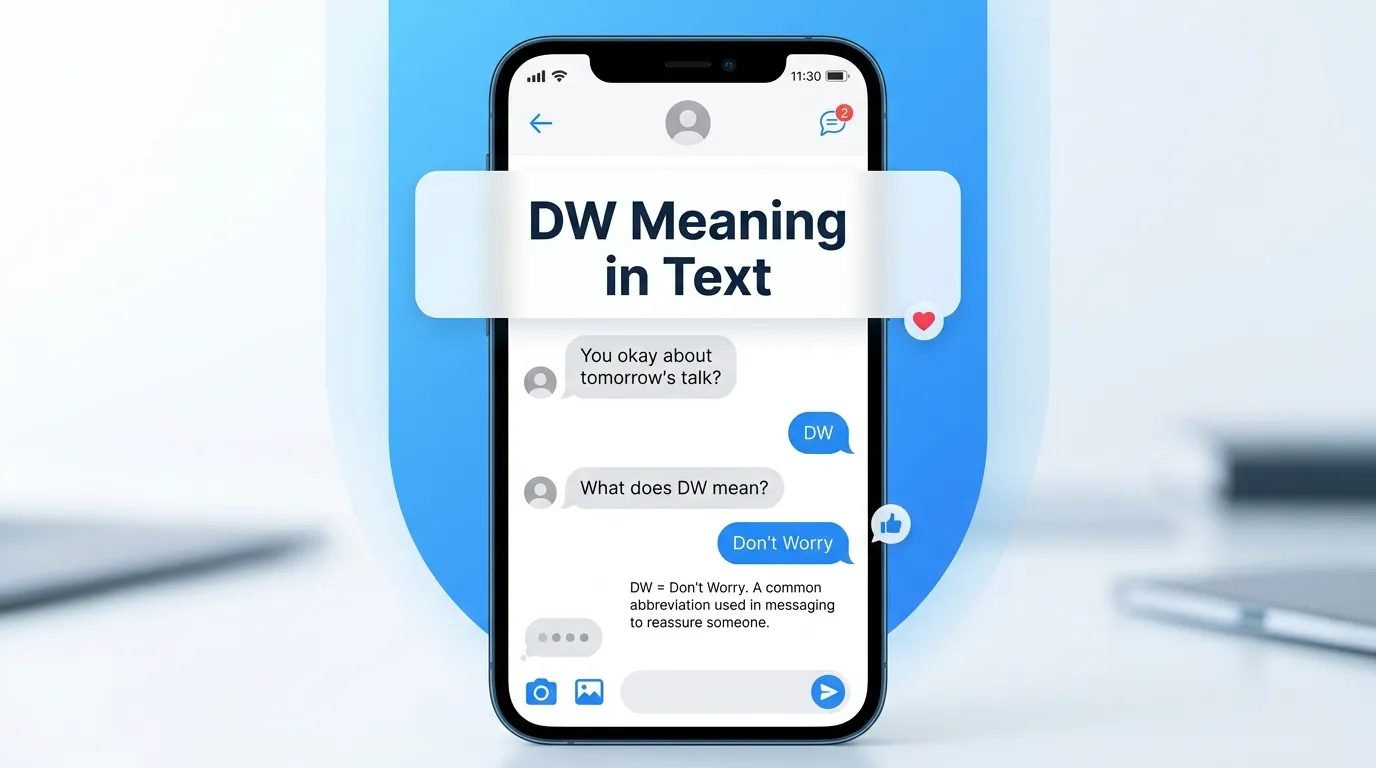
DW in text means don’t worry. It’s a quick, casual way to reassure someone that something isn’t a big deal, that they don’t need to stress, or that a situation is already handled.
You’ll see it in texts, group chats, Snapchat, Instagram DMs, and comment sections everywhere.
This guide breaks down exactly what DW means, how people actually use it in real conversations, when it’s appropriate (and when it might come across wrong), and how it compares to similar abbreviations you’ll run into like NVM, IDW, and NP.
What Does DW Mean?
DW stands for don’t worry. That’s the short answer, and in the vast majority of texts you’ll see, that’s exactly what it means.
It’s used to:
- Calm someone down after a small mistake or misunderstanding
- Reassure someone that a task is already taken care of
- Brush off an apology by saying it wasn’t a big deal
- Respond casually when someone asks if something is okay
Here’s the thing about DW tone matters more than the letters themselves. The same two letters can sound warm and reassuring in one context and dismissive in another, depending on what came before it.
Quick Examples
- I might be 10 minutes late. → dw take your time
- Sorry I forgot to text back! → dw about it lol
- Did you already order food? → yeah dw I got it covered
In each case, DW is doing the same job: lowering the emotional temperature of the conversation.
Where DW Came From
DW follows the same pattern as most texting abbreviations it’s built from the first letters of a common phrase, trimmed down for speed. Don’t worry has been a comforting, everyday phrase for decades. As texting culture grew through the 2000s and 2010s, especially on platforms with character limits or fast-paced chat like AIM, MSN Messenger, and later SMS and Snapchat, people naturally shortened frequent phrases to save keystrokes.
DW isn’t tied to one platform or one generation the way some newer slang is. It’s more of a texting utility word practical, low-effort, and universally understood by anyone who’s spent time messaging casually.
How People Actually Use DW in Conversations
Understanding the definition of DW is easy. Understanding how it functions in real conversations takes a bit more nuance, because it shows up in a few distinct situations.
1. Reassurance After Someone Apologizes
This is the most common use. Someone says sorry, and DW signals that no apology was needed in the first place.
Sorry I missed your call dw I was busy anyway
2. Telling Someone Not to Stress About a Task
DW often means something is already handled, so the other person can relax.
Do you need help setting up for the party? dw I got it already
3. Softening Bad or Awkward News
Sometimes DW is used to take the edge off a message that might otherwise feel harsh.
I can’t make it tonight, dw though we’ll hang out this weekend
4. As a Standalone Reply
Sometimes people just send dw by itself, with no other text, as a complete response to a question or apology. This is common in fast-paced group chats where full sentences feel unnecessary.
DW vs. Similar Texting Abbreviations
DW is often confused with a few other short texting terms because they overlap in casual conversation. Here’s how they actually differ.
| Abbreviation | Meaning | Typical Use |
| DW | Don’t worry | Reassuring someone, dismissing an apology |
| NP | No problem | Responding to thank you or a request |
| NVM | Never mind | Dropping a topic or withdrawing a question |
| IDW | I don’t want / I don’t wanna | Expressing reluctance or refusal |
| IDK | I don’t know | Answering a question with uncertainty |
| IKR | I know, right | Agreeing enthusiastically with someone |
The easiest mix-up is DW and NP. They can feel interchangeable, but there’s a subtle difference: NP usually responds to gratitude or a request (thanks! → np), while DW usually responds to concern or an apology (sorry! → dw).
Is DW Formal or Informal?
DW is strictly informal. It belongs in texts, DMs, group chats, and social media comments not in emails, work messages to your manager, or any communication where you’re expected to sound professional.
If you’re texting a close coworker casually, it might be fine. If you’re messaging a client, your boss, or anyone in a formal context, spell it out: Don’t worry about it, I’ve got it handled.
A simple rule of thumb: if you wouldn’t use lol or tbh in that conversation, skip dw too.
When DW Might Come Across the Wrong Way
DW is usually harmless, but text lacks tone of voice, so it can occasionally land differently than intended.
- Too brief for a serious topic. If someone’s genuinely upset or anxious about something significant, a one-word dw can feel dismissive rather than comforting. A slightly longer reply usually reads as more sincere.
- Sarcastic undertones. In some contexts, especially if there’s tension in the conversation, dw can be read as passive-aggressive almost like don’t worry about it said with an eye-roll.
- Repeated use without follow-through. If someone keeps saying dw about something and it never actually gets resolved, it starts to lose its reassuring effect.
When in doubt, especially in emotionally sensitive conversations, it’s worth adding a few extra words instead of relying on the abbreviation alone.
How to Reply When Someone Sends You DW
If someone texts you dw, you generally don’t need an elaborate response. Common replies include:
- ok thank you
- lol ok
- A simple thumbs-up or heart reaction
- you sure? if you want to double-check they mean it
There’s no pressure to match the brevity replying with a full sentence is completely normal too.
A Quick Checklist for Using DW Correctly
- ✅ Use it in casual texts, DMs, and group chats
- ✅ Use it to reassure someone or dismiss a small apology
- ✅ Use it when a task or situation is already handled
- ❌ Don’t use it in professional or formal messages
- ❌ Don’t rely on it alone for serious emotional conversations
- ❌ Don’t assume everyone knows it older or less texting-savvy contacts might not
FAQs
Q: DW meaning in whatsapp
A: DW on WhatsApp usually means “Don’t Worry,” and it is used to reassure someone.
Q: DW meaning from a girl
A: When a girl says DW, it usually means “Don’t Worry” in a caring or reassuring way.
Q: What does dw mean Snapchat
A: On Snapchat, DW most commonly means “Don’t Worry.”
Q: DW Meaning from a boy
A: When a boy uses DW, it usually means “Don’t Worry” to comfort or reassure someone.
Q: Dw meaning in medical
A: In medical settings, DW can have different meanings depending on the hospital or clinical context.
Q: Dw meaning in text urban dictionary
A: According to online slang usage, DW commonly stands for “Don’t Worry.”
Q: Dw meaning in discord
A: On Discord, DW usually means “Don’t Worry” during chats and conversations.
Q: Dw meaning in roblox
A: In Roblox chats, DW most commonly stands for “Don’t Worry.”
Conclusion
DW means don’t worry a quick, casual way to reassure someone in texts, DMs, and group chats. It works well for brushing off small apologies or letting someone know a task is handled, but it’s worth spelling out fully in professional settings or serious emotional conversations where a couple extra words go a long way.
Next time you see dw pop up in a chat, you’ll know exactly what’s being said and now you can use it with confidence too.
Discover more Post
- WYA Meaning in Text: Examples, Uses & Replies
- What Is MYF Meaning in Text? Full Guide
- MBN Meaning in Text: Everything You Need to Know
- FT Meaning in Text: Complete Chat & Social Media Guide

As Mark Twain once said, “The human race has only one really effective weapon, and that is laughter.” At Goffaws.com, we couldn’t agree more—especially when it comes to CrossFit puns and jokes. Fitness may be about strength and endurance, but a good laugh can be the best workout of all. From playful gym humor to clever word twists that would make Twain chuckle, we’re here to prove that comedy and conditioning are the perfect pair.