You’re scrolling through a group chat and someone types imo this movie is overrated. No context, no explanation, just three lowercase letters doing a lot of work.
If you’ve ever paused mid-conversation trying to figure out what someone meant, you’re not alone and the answer is simpler than you’d think.
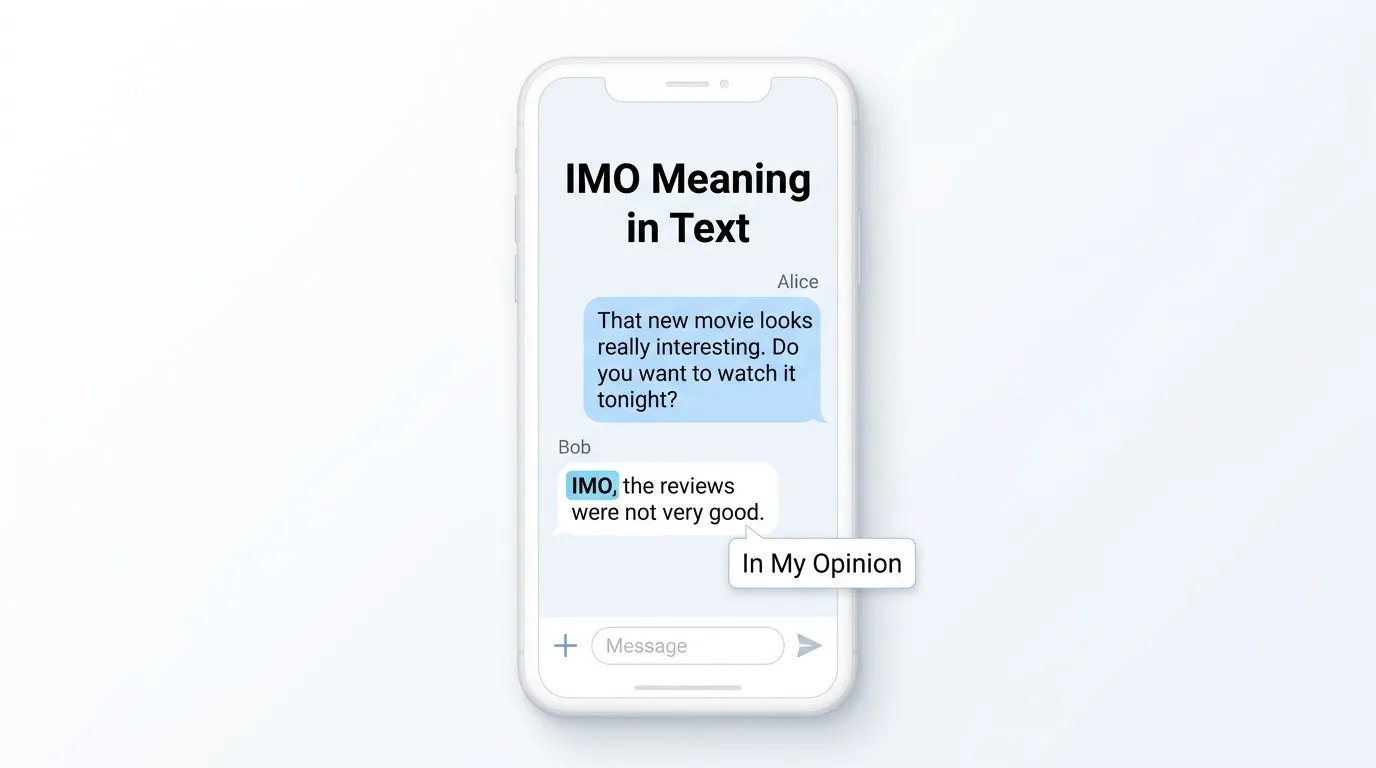
IMO stands for in my opinion. It’s a texting abbreviation people use to signal that what follows is a personal view, not a stated fact.
This guide covers exactly what IMO means, how it’s used in real conversations, how it differs from similar terms like IMHO, and when it might not be the right fit.
What Does IMO Mean?
IMO is short for in my opinion. People drop it into a sentence right before sharing a take, a preference, or a judgment call basically anywhere they want to make clear that what they’re saying is subjective.
Here’s the thing that trips people up: IMO isn’t really about softening a statement. It’s about labeling it. When someone writes imo the sequel was better, they’re not necessarily being polite or hesitant they’re flagging that this is their personal read on something, not an objective claim you’re supposed to just accept.
This matters in text because tone doesn’t come through the way it does in speech. Without IMO, a blunt statement like that restaurant is terrible can read as a definitive judgment. Add imo in front of it, and it shifts into something more like a shared thought: here’s how I see it, take it or leave it.
Where IMO Came From
IMO has roots in early internet culture, particularly forums and chatrooms from the 1990s and early 2000s, where space was limited and typing fast mattered. Abbreviations like BRB, LOL, and IMO became shorthand that regular users understood instantly, even if newcomers had to learn the code.
It’s part of a broader family of opinion-signaling abbreviations that internet communities developed to make fast-paced typed conversation feel more natural closer to how people actually talk, where a quick I think or if you ask me gets tossed in without much thought.
How to Use IMO in a Sentence
IMO usually sits at the start, middle, or end of a sentence, depending on how the person is texting. There’s no strict grammar rule it functions more like a conversational tag than a formal part of speech.
Common placements:
- Start of sentence: IMO, we should just order pizza.
- Middle of sentence: That show, imo, went downhill after season two.
- End of sentence: This place has the best tacos in town, imo.
It’s almost always written in lowercase in casual texting, though some people capitalize it at the start of a sentence out of habit. Either way is understood capitalization doesn’t change the meaning.
A Few Real Examples
- imo you should just call him instead of texting back and forth
- Best phone on the market rn, imo
- That was a rough ending imo, felt rushed
- imo we’re overthinking this
Notice that IMO tends to show up in casual, low-stakes conversations recommendations, reactions to media, quick takes on decisions. It’s not typically used in formal writing.
IMO vs. IMHO: What’s the Difference?
This is one of the most common mix-ups, so it’s worth breaking down clearly.
| Abbreviation | Full Meaning | Tone | Typical Use |
| IMO | In My Opinion | Neutral to confident | Everyday texting, casual takes |
| IMHO | In My Humble Opinion | Slightly softer, more deferential | Situations where the person wants to seem less assertive |
Functionally, both phrases do the same job they mark a statement as opinion rather than fact. The difference is mostly in tone. IMHO leans into a bit more modesty, even if the humble part is often used loosely or even a little sarcastically online. IMO is more direct and doesn’t try to soften anything.
In practice, most people use whichever one they’re used to typing, and readers generally treat them as interchangeable. If you’re aiming for precision, use IMHO when you want to come across as more tentative, and IMO when you just want to state your view plainly.
When (and When Not) to Use IMO
IMO works well in specific situations, but it’s not a fit for every conversation. Here’s a quick way to think about it.
Good times to use IMO:
- Giving a casual recommendation (that new coffee shop is overpriced, imo)
- Sharing a reaction to something you both experienced
- Disagreeing gently in a group chat without sounding harsh
- Weighing in on a low-stakes decision, like where to eat or what to watch
When to skip it:
- Formal emails or professional messages, where in my opinion written out (or no qualifier at all) reads better
- Situations where you actually do have expertise and want to sound confident, not casual
- Text meant for someone unfamiliar with texting abbreviations, like an older relative or a new contact, where spelling it out avoids confusion
A simple checklist can help you decide fast:
- [ ] Is this a casual, personal message? → IMO works fine
- [ ] Is this a work email or formal document? → Spell it out or drop the abbreviation
- [ ] Is the recipient unfamiliar with texting slang? → Use the full phrase instead
- [ ] Are you stating a fact, not an opinion? → Don’t use IMO at all it would undersell your point
Common Mistakes People Make With IMO
A few small missteps come up often enough to mention.
Using it for facts. IMO signals opinion, so using it before a factual, verifiable statement (imo the earth is round) just sounds odd or confusing. Save it for genuinely subjective takes.
Overusing it in one message. Dropping IMO into every sentence of a long text can feel repetitive and start to read as unsure or hedgy, even if that’s not the intent.
Assuming everyone knows it. Not everyone grew up texting in abbreviations. If you’re messaging someone outside your usual circle a coworker, a client, an older family member it’s often clearer to just write in my opinion.
Similar Texting Abbreviations Worth Knowing
IMO belongs to a small cluster of opinion-related shorthand you’ll likely run into alongside it:
- IMHO – In My Humble Opinion
- TBH – To Be Honest
- IIRC – If I Recall Correctly
- FWIW – For What It’s Worth
- NGL – Not Gonna Lie
These all serve a similar purpose: they let the writer flag how confident or personal a statement is, without needing a full sentence to explain it.
FAQs
Q: Imo meaning in text from girl
A: IMO from a girl usually means “In My Opinion” when she is sharing her personal thoughts.
Q: Imo meaning in text funny
A: IMO is sometimes used in funny conversations to share a playful or humorous opinion.
Q: Imo meaning in text urban dictionary
A: On Urban Dictionary, IMO is commonly defined as “In My Opinion” in online chats.
Q: What is IMO in social media
A: On social media, IMO stands for “In My Opinion” and is used to express a personal viewpoint.
Q: IMO meaning in shipping
A: In shipping, IMO stands for the International Maritime Organization, which regulates global maritime safety.
Q: What does IMO mean on snapchat
A: On Snapchat, IMO usually means “In My Opinion” when someone shares their view.
Q: Imo meaning in Korean
A: In Korean, “imo” (이모) means maternal aunt or a respectful term for a middle-aged woman.
Q: IMO meaning in business
A: In business, IMO can refer to the International Maritime Organization or have a company-specific meaning depending on the context.
Conclusion
IMO simply means in my opinion a quick way to flag that what you’re saying is a personal take, not a stated fact. It works best in casual texts, group chats, and quick reactions, and it’s less suited to formal writing or messages to people unfamiliar with texting shorthand.
Next time you see it or want to use it yourself you’ll know exactly what’s being communicated. And if you’re ever unsure whether it fits the moment, a quick rule of thumb works: casual chat, use it; formal message, spell it out.
Discover More Post
- ISTG Meaning in Text: Chat & Social Media Guide
- SMH Meaning in Text: Complete Guide 2026
- WTW Meaning in Text: What It Really Means
- WYO Meaning in Text: Simple Meaning & Uses

At Goffaws.com, we celebrate words that move, inspire, and connect us—and few voices have done that better than Maya Angelou. A poet, author, and civil rights icon, Angelou used her powerful storytelling to speak truth, courage, and compassion into the world. Her timeless wisdom reminds us that even in struggle, there is beauty; even in silence, there is power. Join us as we explore the life, legacy, and lessons of one of history’s most inspiring voices.