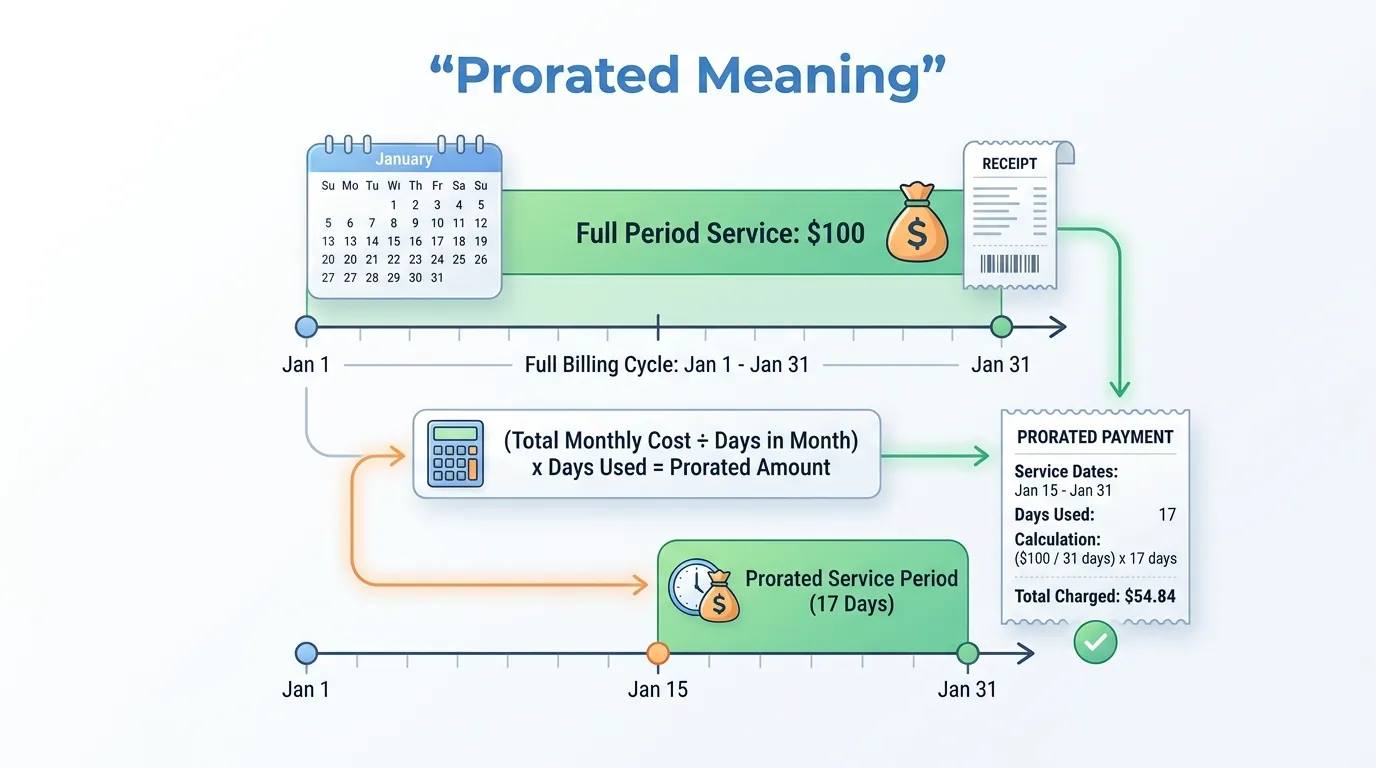
Prorated means something has been divided or calculated in proportion to a smaller amount of time, quantity, or use instead of the full amount.
If you start a job mid-month or move into an apartment on the 15th, your pay or rent is usually prorated so you only cover the portion that applies to you.
This article walks through the exact meaning, the everyday situations where it shows up, simple ways to calculate it, and practical examples so you can handle the next prorated bill, paycheck, or refund with confidence.
The Simple Definition of Prorated
“Prorated” (sometimes written “pro-rated”) comes from the Latin phrase pro rata, which means “in proportion” or “according to the calculated share.” In modern use it describes any amount that has been adjusted so it matches only the fraction of a full period or total that actually applies.
You will most often see it with money: rent, salary, insurance premiums, subscription fees, or refunds. The core idea stays the same fairness based on actual time or usage rather than a full fixed charge.
Related terms you will encounter:
- Prorate (verb): to divide or calculate proportionately.
- Proration: the act or result of prorating.
- Pro rata: the Latin root still used in legal and formal contexts; in everyday American English, “prorated” is far more common.
How Prorated Amounts Work in Real Life
People run into prorated figures in several common places.
Rent and leases. Landlords frequently prorate the first or last month’s rent when a tenant moves in or out mid-month. You pay only for the days you occupy the unit.
Salary and wages. New hires who start mid-pay period, or employees who leave early, usually receive a prorated paycheck. Part-time staff may also see benefits or paid time off calculated on a prorated basis relative to full-time hours.
Subscriptions and services. Software, streaming, gym memberships, and insurance policies often prorate charges or refunds when you start, cancel, or change plans mid-cycle.
Utilities and other bills. Some utility companies bill based on actual days of service rather than a flat monthly rate.
Other contexts. Sports contracts, warranty coverage that declines over time, and certain investment distributions can also use proration.
In each case the goal is the same: charge or pay only for the portion that was actually used or earned.
How to Calculate a Prorated Amount
The basic math is straightforward. You need three pieces of information:
- The full amount for the complete period (monthly rent, annual salary, etc.).
- The length of the full period (days in the month, working days, hours, etc.).
- The actual portion that applies (days lived in the unit, days worked, hours used).
Simple formula
Prorated amount = Full amount × (Actual portion ÷ Full period)
Example 1: Prorated rent
Monthly rent is $1,500. The month has 30 days. You move in on the 16th and stay 15 days.
Daily rate = $1,500 ÷ 30 = $50.
Prorated rent = $50 × 15 = $750.
Example 2: Prorated salary
Annual salary is $60,000. You start work on July 1 and the company pays on a calendar-year basis. You work half the year, so your first-year pay is roughly $30,000. (Many employers use actual working days or pay periods for greater precision.)
Example 3: Subscription upgrade mid-month
You pay $20 for a basic plan and upgrade to a $50 plan with 15 days left in a 30-day month.
Credit for unused basic plan: $20 × (15/30) = $10.
Charge for new plan: $50 × (15/30) = $25.
Net amount due for the remainder of the month: $25 − $10 = $15.
Always confirm the exact method with the other party. Some landlords use a 30-day month regardless of the calendar; some payroll systems count only business days. Small differences in the denominator can change the final number.
Quick Comparison: Common Proration Situations
| Situation | Typical Full Period | What Gets Prorated | Common Calculation Basis |
| Apartment rent | Calendar month | First or last month’s rent | Days of occupancy |
| Employee salary | Pay period or year | Starting or ending paycheck | Days or hours worked |
| Software subscription | Billing cycle | Mid-cycle start, cancel, upgrade | Days remaining in cycle |
| Insurance premium | Annual or monthly term | Partial-term coverage | Days of coverage |
| Utility bill | Billing period | Service start or stop | Actual days of service |
Why Companies and Landlords Prorate
Proration creates fairness. Charging a full month’s rent for half a month of occupancy would feel one-sided. Paying a full salary for only two weeks of work would do the same in the other direction. By adjusting amounts to actual use, both sides avoid over- or under-payment.
It also simplifies accounting. Businesses can keep consistent monthly or annual figures while still handling partial periods cleanly. For customers, transparent proration builds trust especially when refunds or credits appear on the next bill.
Practical Tips When You Encounter Proration
- Ask how the calculation is done. Confirm whether the provider uses calendar days, a fixed 30-day month, or business days.
- Keep records of start and end dates. A clear paper trail makes it easy to verify the math.
- Watch for rounding. Some systems round to the nearest cent or dollar; others truncate.
- Check the fine print on subscriptions. Many services prorate automatically; others only credit on the next cycle or not at all.
- For salary, clarify whether benefits, bonuses, or paid time off are also prorated.
These small steps prevent surprises and give you a basis for discussion if numbers look off.
FAQs
Q: Prorated meaning in finance
A: Prorated in finance means an amount is divided or calculated based on the proportion of time or usage involved.
Q: Prorated salary meaning
A: Prorated salary means an employee receives pay based on the portion of the pay period they actually worked.
Q: Prorated meaning in accounting
A: Prorated in accounting means allocating an amount proportionally across a specific period, expense, or category.
Q: Prorated meaning in work
A: Prorated in work means pay, benefits, or hours are adjusted according to the amount of time worked.
Q: Prorated rent meaning
A: Prorated rent means paying only for the portion of the rental period that you occupy the property.
Q: Prorated meaning synonyms
A: Synonyms for prorated include proportionate, proportional, allocated, divided, and apportioned.
Q: Prorated meaning leave
A: Prorated leave means vacation or other leave is calculated according to the portion of the year an employee works.
Q: Prorated meaning in insurance
A: Prorated in insurance means a premium, refund, or benefit is calculated proportionally based on the covered period or amount.
Conclusion
Prorated simply means adjusted in proportion most often to the actual time or quantity involved rather than a full fixed amount. Whether you are dealing with rent, a paycheck, a subscription, or an insurance premium, the same basic idea applies: you pay or receive only your fair share of the whole.
The next time you see the word on a bill or offer letter, you now have the tools to understand the calculation and confirm it is correct. If the numbers still look unclear, ask for the exact formula used. Clear communication keeps both sides on the same page.
Discover More Post
- DTM Meaning in Text: Full Meaning & Uses
- WDYM Meaning in Text: Meaning, Uses & Examples
- PMO Meaning in Text: Full Meaning & Examples
- FYM Meaning in Text: Meaning, Uses & Examples

As Mark Twain once said, “The human race has only one really effective weapon, and that is laughter.” At Goffaws.com, we couldn’t agree more—especially when it comes to CrossFit puns and jokes. Fitness may be about strength and endurance, but a good laugh can be the best workout of all. From playful gym humor to clever word twists that would make Twain chuckle, we’re here to prove that comedy and conditioning are the perfect pair.