If you got a text that just says TMB and you’re not sure what your friend, partner, or coworker is trying to tell you, you’re not alone.
It’s one of those abbreviations that shows up constantly in DMs and group chats, but almost nobody explains it clearly.
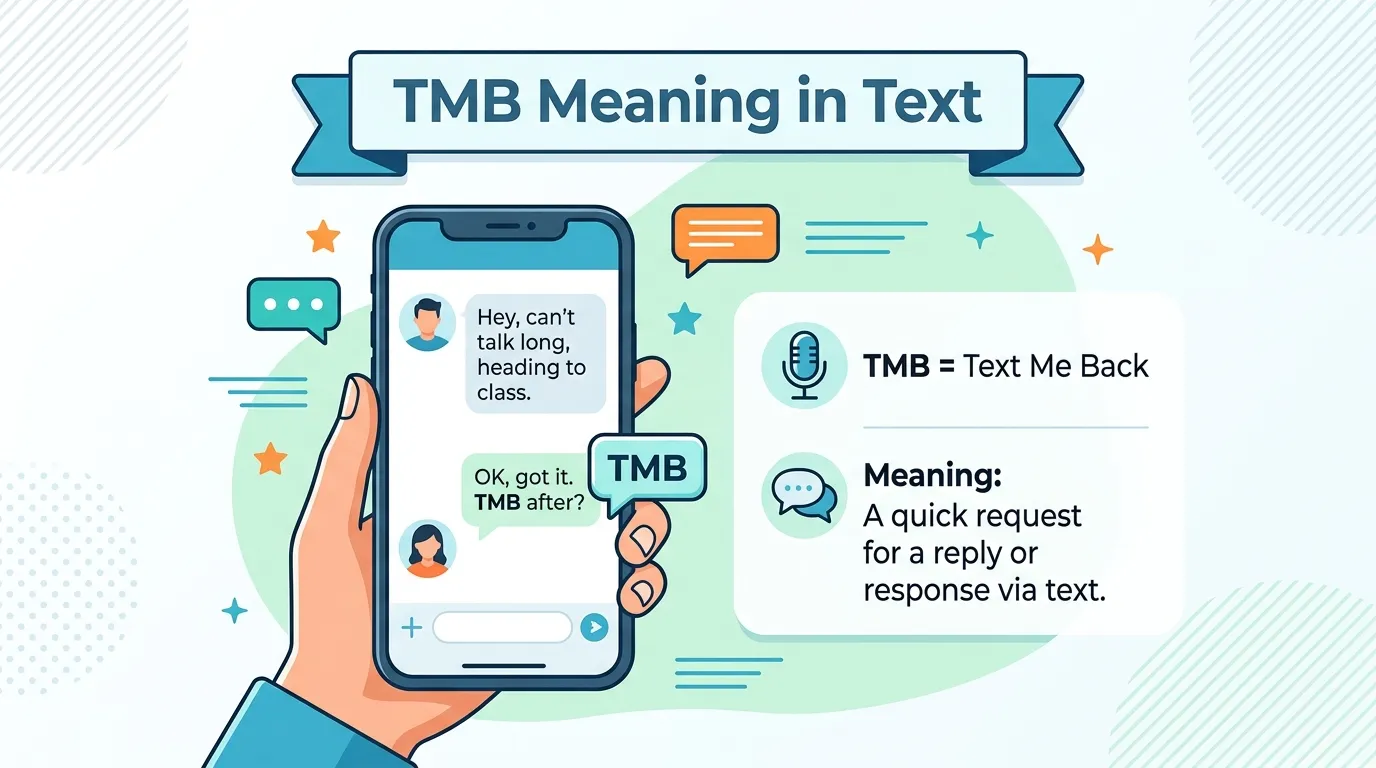
Here’s the short answer: TMB usually stands for Text Me Back. It’s a quick, informal way of asking someone to reply to a message, whether that’s out of urgency, boredom, or just wanting to keep a conversation going.
But TMB isn’t always that simple. Depending on the platform, the relationship between the people texting, and the tone of the conversation, it can mean something a little different or occasionally something unrelated entirely.
In this guide, you’ll learn what TMB means in the most common situations, how to tell the difference between a casual TMB and an urgent one, real examples from actual conversations, and what to say back so you don’t leave anyone hanging.
What Does TMB Stand For?
TMB most commonly means Text Me Back. It’s part of a family of texting abbreviations built for speed similar in spirit to things like LMK (let me know) or HMU (hit me up). The goal is the same: ask for a reply without spelling out the whole request.
You’ll see it most often at the end of a message, functioning almost like a soft nudge:
Hey, I saw something today that reminded me of you. TMB when you get a sec.
That’s the core use case. Someone sent a message, they want a response, and TMB is the shorthand way of saying so.
Where TMB Comes From
Abbreviations like TMB grew out of the same habits that shaped most texting slang: character limits on early SMS plans, the speed of typing on small keyboards, and a culture that rewards short, punchy phrasing. Spelling out text me back every time got repetitive, so it got compressed into three letters.
It stuck around because the need didn’t go away. Even with unlimited texting and messaging apps that show read receipts, people still want a fast way to ask for a reply so TMB carried over into DMs, comments, and captions on platforms like Instagram, Snapchat, and TikTok.
How TMB Is Used in Real Conversations
Context changes a lot about how TMB lands. Here’s how it typically plays out across different situations.
Among Friends
Between friends, TMB is casual and low-stakes. It’s less a demand and more a reminder the texting equivalent of a light tap on the shoulder.
Friend: Guess who I ran into today 👀 TMB
There’s no real pressure here. It just signals I want to keep talking about this whenever you’re free.
In Romantic or Emotional Messages
In dating or relationship texts, TMB tends to carry a bit more feeling. It can express that someone is thinking about the other person, missing them, or hoping to hear back sooner rather than later.
Can’t stop thinking about last night 🥰 TMB when you’re free
The tone here is affectionate rather than demanding, even though the words are identical to a casual use case.
On Social Media (Snapchat, Instagram, TikTok)
On social apps, TMB shows up in DMs, comments, and captions. It usually still means text me back, but the vibe can range from lighthearted to attention-seeking, especially in comment sections where the sender wants a public reply, not just a private one.
In Work or Formal Settings
TMB doesn’t really belong in professional communication. In an email to a coworker or a message to a client, it reads as too casual and can come across as unclear or even a little unprofessional. If you need a reply in a work context, it’s better to just write out the request: Let me know when you get a chance or Please confirm by Friday.
TMB Meaning by Context: Quick Reference Table
| Setting | Likely Meaning | Tone |
| Casual chat with friends | Text me back | Light, no pressure |
| Dating or relationship texts | Text me back | Affectionate, hopeful |
| Snapchat / Instagram DMs | Text me back | Casual to slightly urgent |
| TikTok comments | Text me back or a joke/inside meaning | Playful, context-dependent |
| Group chats | Reply when you can | Neutral reminder |
| Work emails or business chats | Not appropriate spell it out instead | N/A |
Does TMB Ever Mean Something Else?
Almost always, TMB in a text conversation means text me back. That said, slang shifts depending on the group of people using it, and a few less common variations do exist:
- Tag me back occasionally used on Instagram when someone wants to be tagged in a related post.
- Trust me, bro shows up sometimes in casual banter, unrelated to replying to a message.
- Niche or inside-joke meanings specific to a particular friend group or online community.
These alternate meanings are far less common than text me back, and you can usually tell them apart from context. If someone just sent you a message and ended it with TMB, they almost certainly want a reply not a tag or a favor.
Outside of texting, TMB is also a recognized abbreviation in other fields entirely unrelated to slang for example, in chemistry, TMB refers to a compound used in certain lab tests. That meaning has nothing to do with how the term is used in a text message, but it’s worth knowing if you come across TMB somewhere outside a chat app.
Is TMB Rude or Demanding?
Not by default. TMB is neutral slang; it’s the tone of the surrounding message and your relationship with the sender that determines how it feels. A cheerful TMB whenever you’re free 😊 reads completely differently from a blunt tmb. with no punctuation or emoji softening it.
If you’re unsure how someone means it, look at:
- Punctuation and emojis softer punctuation usually signals a relaxed tone.
- The rest of the message is lighthearted, urgent, or emotional?
- Your history with that person some people just naturally text more bluntly than others.
How to Respond to TMB
There’s no single correct reply; it depends on your situation. A few solid options:
- If you can reply right away: just answer their original message. TMB is a request, not a separate question.
- If you’re busy: a quick will do, kinda swamped and keeps things friendly without ignoring the ask.
- If it feels urgent: prioritize a reply, even a short one, especially in a relationship or family context where silence can read as concerning.
- If you don’t understand what they’re asking: it’s fine to just say what’s up? TMB itself doesn’t carry information, it just asks for a response.
When You Shouldn’t Use TMB
A few situations where it’s better to skip the abbreviation and just spell things out:
- Professional emails or messages to clients use please reply when convenient instead.
- Messages to someone unfamiliar with texting slang parents, older relatives, or anyone who might not recognize the abbreviation.
- Formal or academic communication assignments, school portals, or official correspondence.
- Anything time-sensitive and important for real urgency, be direct: Can you call me back today? It’s important.
FAQs
Q: Tmb meaning in text Spanish
A: In Spanish texting, TMB commonly means también, meaning also or too.
Q: What does tmb mean on instagram
A: On Instagram, TMB usually means también or too, especially in Spanish conversations.
Q: Tmb meaning in text funny
A: In funny texting contexts, TMB can be used as a playful abbreviation for también or too.
Q: What does tmb mean on snapchat
A: On Snapchat, TMB commonly means también in Spanish texting.
Q: Tmb meaning in text urban dictionary
A: Urban Dictionary may list TMB with several meanings depending on the slang and context.
Q: What Does TMB mean on tiktok
A: On TikTok, TMB commonly means también, which translates to also or too in English.
Q: Tmb meaning in medical
A: In medical contexts, TMB can mean tumor mutational burden, a measure of mutations found in a tumor.
Q: TTMB meaning in text
A: TTMB can have different meanings in texting, so its exact meaning depends on the conversation and context.
Conclusion
TMB is a simple, widely understood piece of texting shorthand for text me back. In most conversations with friends, partners, or in casual DMs that’s exactly what it means, and the tone will tell you whether it’s a light reminder or something more pressing.
The main thing to remember: it belongs in casual, informal messaging, not in professional or formal communication. Once you know that, decoding a TMB text (and figuring out how to respond) becomes second nature. Next time you see it, you’ll know exactly what’s being asked and you can reply accordingly.
Discover More Post
- JS Meaning in Text: Simple Guide & Examples
- ATM Meaning in Text: Meaning, Uses & Examples
- IDM Meaning in Text: Easy Guide With Examples
- BTW Meaning in Text: Simple Guide & Examples

At Goffaws.com, we celebrate words that move, inspire, and connect us—and few voices have done that better than Maya Angelou. A poet, author, and civil rights icon, Angelou used her powerful storytelling to speak truth, courage, and compassion into the world. Her timeless wisdom reminds us that even in struggle, there is beauty; even in silence, there is power. Join us as we explore the life, legacy, and lessons of one of history’s most inspiring voices.