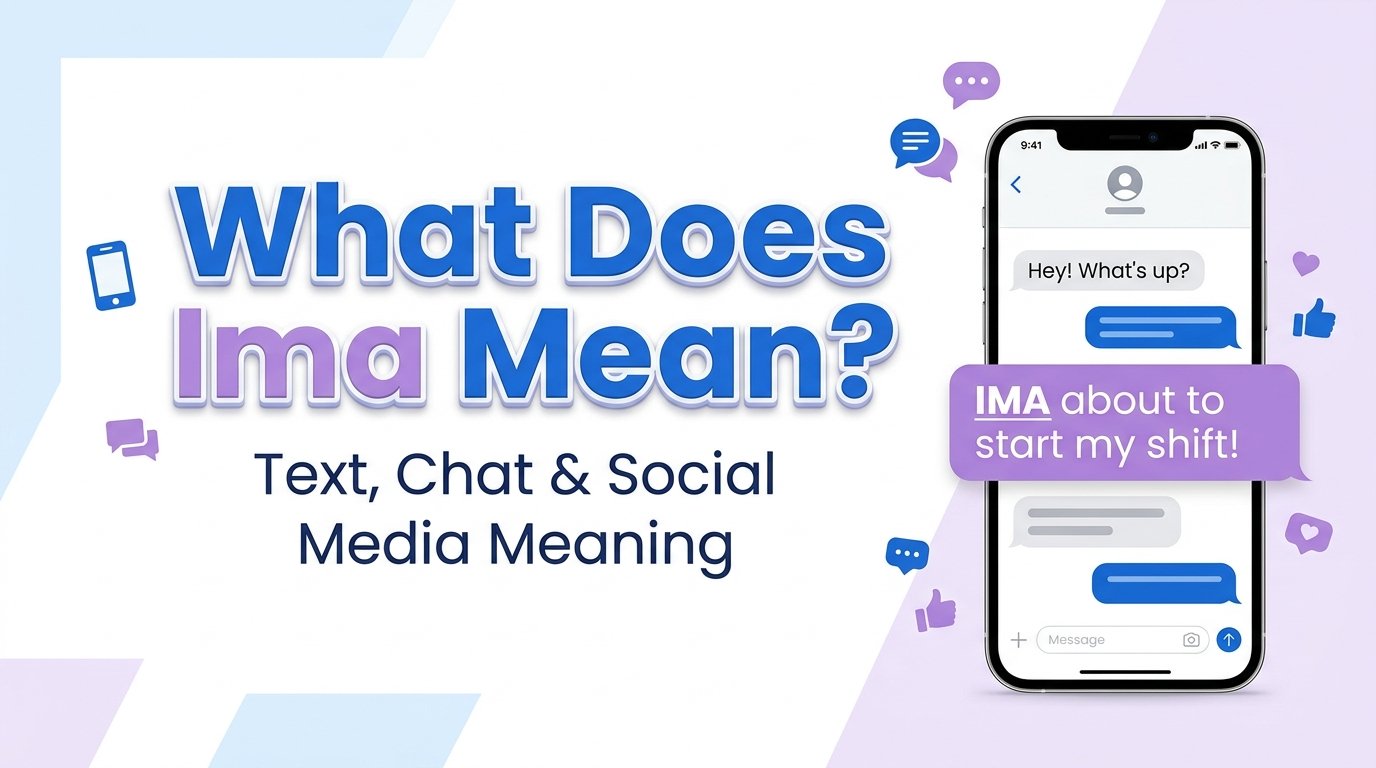
If you have seen the word ima in a text message, on social media, or in the lyrics of a song, you might have paused and wondered what it means.
The short answer is that ima is a casual, spoken-style way of saying I am going to. People use it when they want to talk about something they plan to do very soon.
It is not a formal word, and you will not find it printed in a school textbook, but you will see it everywhere online, in texts, and in everyday conversation.
This word is a great example of how the English language changes when people speak quickly and casually.
In this article, you will learn exactly what ima means, where it came from, how to use it correctly, and how it is different from similar phrases like I’ma or imma.
By the end, you will fully understand this common slang term and feel confident spotting it the next time it shows up in your messages.
Quick Answer
Ima means I am going to. It is a shortened, informal way to say you plan to do something. For example, Ima call you later simply means I am going to call you later. People mostly use this word when speaking casually or texting friends, not in formal writing like school papers or business emails.
Meaning or Definition
The word ima works as a stand-in for three words: I am going to. When people talk fast, they often blend words together to save time and breath. Over many years, I am going to slowly turned into I’m gonna, and then it got even shorter, becoming ima or imma.
Here is a simple way to picture it. Think about how do not becomes don’t, or how cannot becomes can’t. Those are called contractions. Ima works in a similar spirit, even though it is not an official contraction with an apostrophe rule like don’t has. It is more of a spoken slang shortcut that eventually made its way into written text.
So when someone types, Ima eat dinner now, they mean, I am going to eat dinner now. The meaning stays the same. Only the way it sounds and looks on the page changes.
| Full Phrase | Slang Version | Meaning |
| I am going to | Ima | Expresses a near-future plan |
| I am going to go | Ima go | Announces an action you plan to take |
| I am going to try | Ima try | Shows intent to attempt something |
| I am not going to | Ima not / I ain’t gonna | Shows a plan NOT to do something |
Grammar or Correct Usage
Even though ima is informal, there are still some natural patterns to how people use it. Understanding these patterns will help you use the word correctly if you decide to use it in a text or casual chat.
First, ima almost always comes right before a verb. That verb describes the action the speaker plans to do. For example, Ima study tonight or Ima call mom. You would not usually see ima standing alone without an action word after it.
Second, ima is meant for near-future actions, not things that happened in the past or things that are happening right now. It points toward something that will happen soon or eventually. If you are describing something already happening, you would use a different phrase, like I am or I’m.
Third, since ima is slang, it does not follow strict grammar rules the way formal English does. You will not find agreed-upon spelling rules for it in a dictionary of standard grammar. Some people write it as ima, others write imma, and some even write I’ma with an apostrophe. All three versions are understood the same way by most readers.
Because this word is so casual, it belongs in text messages, social media posts, song lyrics, and relaxed conversations with friends. It does not belong in school essays, cover letters, resumes, or professional emails. Teachers and employers expect standard English in those settings, so it is smart to save ima for casual chats only.
Origin or History
The word ima grew out of natural speech patterns in English, particularly from African American Vernacular English (AAVE), which has shaped a great deal of modern American slang and popular music. Over time, phrases naturally get shortened as people speak quickly in everyday conversation. I am going to slowly became I’m gonna, and speakers continued to blend the sounds until it became ima or imma.
This kind of language change is completely normal. English has been doing this for centuries. Words like goodbye actually came from the phrase God be with ye, shortened over hundreds of years of casual use. Ima is a modern example of the exact same process, just happening much faster because of how quickly slang spreads through music, texting, and social media today.
Common Mistakes
People often mix up ima with a few similar-looking words and phrases. Here are the mistakes to watch out for so you do not get confused.
One common mix-up is confusing ima with I’m a, which can sometimes describe identity, like I’m a teacher. This is different from ima, which describes a future action. Reading the full sentence carefully usually makes the meaning clear. I’m a doctor describes who someone is, while Ima call the doctor describes something someone plans to do.
Another mistake is assuming ima is a name. Since it looks like it could be a short name for someone, like Emma spelled differently, some readers get confused at first glance. Context almost always clears this up quickly, since the surrounding words will describe an action.
Ima meaning
IMA is a casual texting abbreviation that usually means “I’m a.” It is often used when someone wants to describe themselves, introduce what they are about to do, or start a sentence quickly. For example, “ima good friend” can mean “I’m a good friend,” while “ima student” means “I’m a student.” In fast texting, people often leave out punctuation and spaces, so “I’m a” may appear as “ima.” The exact sentence matters because IMA can look different from standard written English. It is mainly used in informal messages, social media posts, comments, and chats rather than formal writing.
Ima meaning in text
In texting, ima most commonly represents “I’m a.” It is a shortened, informal way to write the beginning of a sentence. Someone might text “ima busy person” instead of writing “I’m a busy person.” You may also see it written as “imma,” especially when the speaker is using casual internet slang. Because texting often removes apostrophes and spaces, IMA can look like a single word even though it comes from a longer phrase. It is best understood from the words that follow it. When IMA appears before a noun or description, “I’m a” is usually the intended meaning.
What does ima mean
“Ima” can mean “I’m a” in casual writing, especially when it appears before a noun or description. For example, “ima beginner” means “I’m a beginner.” It is an informal spelling created by the way people naturally shorten words while texting. However, IMA does not always have the same meaning in every situation. As an uppercase abbreviation, IMA can refer to other terms in different fields. In everyday social media and texting, though, the lowercase form “ima” is usually part of an informal sentence. Looking at the words immediately after it can quickly show which meaning the writer intended.
I’m a
“I’m a” is the standard English form behind the informal texting expression “ima.” It is a contraction of “I am” followed by the article “a,” and it is normally used before a singular noun. For example, “I’m a teacher,” “I’m a student,” and “I’m a big fan” are all complete sentences. In casual online writing, some people type “ima” because it is quicker and sounds more like natural speech. The meaning stays the same, but “I’m a” is the correct form for standard English. Use the standard version in school, work, professional messages, and other formal writing.
What does ima mean in text
When someone asks “What does ima mean in text?”, the usual answer is “I’m a.” It is an informal texting form that appears at the beginning of phrases such as “ima student,” “ima fan,” or “ima beginner.” The writer is simply removing the apostrophe and space to make the message faster and more casual. You may notice this style in social media comments, DMs, gaming chats, and messages between friends. It should not be confused with “imma,” which is commonly used as a slang form of “I’m going to.” The words that come after IMA usually make its intended meaning clear.
I’m a
“I’m a” is the grammatically standard form of the phrase, while “ima” is an informal texting version that may be used in casual communication. The phrase is used when someone is identifying themselves as a person belonging to a certain group, role, or category. For example, “I’m a writer,” “I’m a parent,” or “I’m a beginner” all describe the speaker. Unlike slang spellings, “I’m a” is appropriate in normal written English. If you see “ima” online, it may simply be a relaxed version of these two words. The surrounding sentence will show exactly what the person is describing about themselves.
Ima or imma
IMA and IMMA are not always interchangeable. In casual texting, IMA can mean “I’m a,” especially when it comes before a noun, as in “ima student.” IMMA is commonly used as an informal slang form of “I’m going to,” as in “imma call you later.” This difference is important because the words after the abbreviation usually change the meaning. If someone writes “ima doctor,” they likely mean “I’m a doctor.” If they write “imma leave,” they likely mean “I’m going to leave.” Both forms are informal, so they are better suited to chats and social media than formal English.
Ima meaning in chat
In chat, ima is usually a quick, informal way to write “I’m a.” People may use it when describing themselves or saying what kind of person they are. For example, “ima huge fan of this show” means “I’m a huge fan of this show.” It can make a message sound relaxed and conversational because it follows the fast spelling style common in online chats. However, the same letters can have other meanings in specialized contexts, so the sentence matters. If IMA is followed by a noun such as “friend,” “student,” “fan,” or “beginner,” the “I’m a” interpretation is usually the natural one.
Ima text meaning
The text meaning of “ima” is usually “I’m a,” when it is used before a noun or description. It is an informal spelling that removes the apostrophe and space from the standard phrase. For example, “ima gamer” means “I’m a gamer,” and “ima new user” means “I’m a new user.” You will mostly see this style in casual texting, social media, comments, and online chats. Because “ima” is informal, it may look out of place in formal writing. If you are writing an email, assignment, résumé, or professional message, “I’m a” is the clearer and grammatically standard choice.
| Common Mistake | Why It Happens | Correct Understanding |
| Confusing ima with I’m a | Similar spelling and sound | Ima means future plan; I’m a often describes identity |
| Thinking ima is a name | Looks like a short first name | It is slang for I am going to, not a name |
| Using ima in formal writing | Not realizing it is casual slang | Save it for texts and casual talk only |
| Believing there is only one correct spelling | Different platforms use different versions | Ima, imma, and I’ma are all common and accepted |
Real-Life Examples
Seeing ima used in real sentences makes the meaning click much faster. Below are several everyday examples showing how people naturally use this word in texting and casual conversation.
Ima head to the store, do you need anything? This means the speaker is about to go to the store and is checking if the other person needs something picked up.
Ima finish my homework before dinner. Here, the speaker is telling someone their plan for the rest of the afternoon.
She said ima be there by seven. This example shows ima used inside a quote, describing someone else’s plan in their own words.
Ima be honest with you, I did not like that movie. In this case, ima is used before the word be, which is a very common pattering in casual speech, almost like a warm-up phrase before sharing an honest opinion.
Don’t worry, ima handle it. This shows the word being used to offer reassurance about a future action.
Notice that in every example, ima sits right before an action word, and it always points toward something that has not happened yet.
Current Usage or Trends
Today, ima is extremely common across texting apps, Instagram captions, TikTok comments, and Twitter/X posts. It has become such a normal part of online communication that most people instantly understand it, even if they have never used it themselves.
Younger generations, in particular, use ima heavily in casual digital communication because it is faster to type than I am going to and feels more natural when writing the way you actually talk. Song lyrics across hip-hop, R&B, and even pop music continue to use ima regularly, which keeps the word fresh in popular culture and introduces it to new listeners.
It is worth noting that slang like ima tends to stay flexible. New generations sometimes create their own variations or replace old slang with new terms. Even so, ima has stuck around for many years now, showing it has real staying power in casual American English.
Tips or Best Practices
If you want to use ima naturally, keep a few simple tips in mind. Use it only in casual settings, such as texting friends, chatting on social media, or writing captions. Avoid it completely in school assignments, emails to teachers or bosses, and any writing where you want to appear professional.
Pay attention to the action word that follows ima, since that is where the real meaning of the sentence lives. If you are ever unsure whether your reader will understand the slang, it is always safe to spell out I am going to instead.
Finally, remember that spelling variations like imma and I’ma are all acceptable. Do not worry about finding one correct way to spell it, since there truly is not one official version.
FAQs
Q: What does ima mean in texting
A: In texting, IMA usually means I’m going to or I am going to.
Q: What does IMA mean on instagram
A: On Instagram, IMA usually means I’m going to or I am going to.
Q: What does Ima mean in Hebrew
A: In Hebrew, Ima (אמא) means mother or mom.
Q: What does ima mean in david
A: Ima in David-related Hebrew context can mean mother or mom.
Q: What does ima mean in the bible
A: In biblical Hebrew context, ima is commonly used to mean mother or mom.
Q: What does ima mean on snapchat
A: On Snapchat, IMA usually means I’m going to or I am going to.
Q: Does ima mean mother
A: Yes, Ima means mother or mom in Hebrew.
Q: What does ima mean in the chosen
A: In The Chosen, Ima is used as a Hebrew term meaning mother or mom.
Conclusion
So, what does ima mean? It simply means I am going to, and it is a casual, spoken-style shortcut that has become a regular part of texting, social media, and everyday conversation.
It shows up constantly in song lyrics, captions, and quick messages between friends because it captures the relaxed, natural way people actually talk.
While it is not appropriate for formal writing like essays or work emails, it is completely normal and widely understood in casual settings. The next time you see ima in a text or post, you will know exactly what the person means and can even use it yourself with confidence.
Discover More Post
- What Is IK Full Form? Complete Guide
- DTF Slang Meaning? The Complete Guide to DTF Slang Meaning
- What Does ATP in Chat Mean? Full Guide
- IFYKYK Meaning: What It Really Means and How to Use It

At Goffaws.com, we celebrate words that move, inspire, and connect us—and few voices have done that better than Maya Angelou. A poet, author, and civil rights icon, Angelou used her powerful storytelling to speak truth, courage, and compassion into the world. Her timeless wisdom reminds us that even in struggle, there is beauty; even in silence, there is power. Join us as we explore the life, legacy, and lessons of one of history’s most inspiring voices.