You’ve seen it in texts, heard it in songs, or maybe someone just called you mi amor. What does it actually mean?
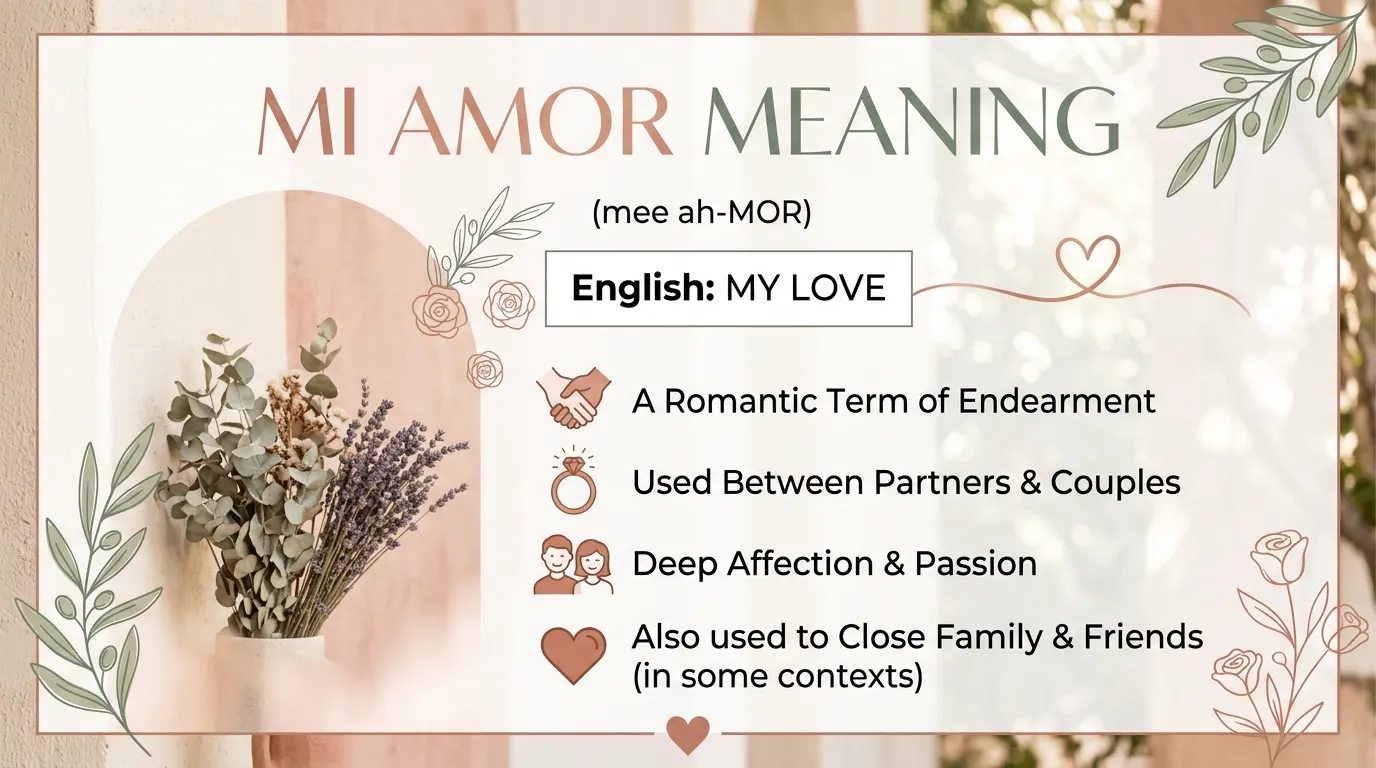
Mi amor means my love in Spanish. It’s one of the most common and flexible terms of endearment used across Spanish-speaking countries.
People use it the same way English speakers say honey, sweetheart, baby, or darling.
In this guide, you’ll get a clear breakdown of the meaning, pronunciation, real-life usage, common mistakes, and other Spanish ways to say my love.
By the end, you’ll know exactly when and how to use it confidently.
What Does Mi Amor Mean Exactly?
Break it down word by word:
- Mi = my
- Amor = love
Put together, mi amor is a direct translation of my love. But in everyday conversation, it functions more like a warm nickname than a literal declaration.
Spanish speakers use it for romantic partners, and in many families it also works for children, parents, or close relatives. The tone and context decide whether it feels romantic, parental, or simply affectionate.
Important note: Amor is a masculine noun in Spanish, but mi amor works for both men and women. You do not change it to mi amora or mi amore. Those are incorrect.
How to Pronounce Mi Amor
Pronunciation is straightforward once you hear it:
- Mee ah-MOR
- Stress falls on the second syllable of amor.
In phonetic spelling you’ll often see: /mi aˈmoɾ/. The r is a soft single flap, not a hard English r.
Practice it slowly a few times and it quickly becomes natural. Many non-native speakers nail it after listening to a couple of examples from native speakers.
When and How People Actually Use Mi Amor
Mi amor appears in everyday situations far more often than formal speech. Here are the most common contexts:
Romantic relationships
Partners greet each other, say goodbye, or soften requests with it.
Examples:
- Hola, mi amor. ¿Cómo estás? (Hello, my love. How are you?)
- Te extraño, mi amor. (I miss you, honey.)
- Buenas noches, mi amor. (Good night, sweetheart.)
Family and children
Parents and grandparents frequently use it with kids. It carries the same warmth as sweetie or my love in English.
Casual affection
In some Latin American countries, close friends or even acquaintances may use it playfully. Tone matters a lotsaid with a smile it feels warm; said with sarcasm it can sound dismissive.
You can also use the phrase as a regular noun phrase meaning the feeling of love itself:
Mi amor por ti es eterno. (My love for you is eternal.)
Common Phrases with Mi Amor
Here are natural, ready-to-use examples:
| Spanish Phrase | Natural English Translation |
| Hola, mi amor | Hi, honey / Hello, my love |
| Te quiero, mi amor | I love you, baby |
| ¿Qué te pasa, mi amor? | What’s wrong, sweetheart? |
| Te extraño mucho, mi amor | I miss you so much, my love |
| Buenos días, mi amor | Good morning, darling |
| Ay, mi amor | Oh, honey (often affectionate or mildly exasperated) |
These work in texts, phone calls, and face-to-face conversation.
Similar Spanish Terms of Endearment
Mi amor is popular, but Spanish has a rich set of affectionate nicknames. Here’s a quick comparison of the most useful ones:
| Spanish Phrase | Literal Meaning | Best Used For | Gender Notes |
| Mi amor | My love | Partners, family, close people | Works for everyone |
| Mi vida | My life | Deep romantic or parental | Neutral |
| Mi corazón | My heart | Romantic or very close | Neutral |
| Mi cielo | My sky / heaven | Soft, affectionate | Neutral |
| Cariño | Dear / darling | Everyday warmth | Neutral |
| Mi querido / Mi querida | My dear | Slightly more formal or written | Changes with gender |
| Amorcito / Amorcita | Little love | Playful, often for children or partners | Diminutive, gender-specific |
Many people mix these freely. Amor alone (without mi) is also extremely common among couplesit’s shorter and feels more casual, similar to calling someone love in English.
Common Mistakes to Avoid
- Wrong gender forms – Do not say mi amora or mi amore. Stick with mi amor.
- Overusing it too early – In a new romantic interest, jumping straight to mi amor can feel intense. Cariño or simply the person’s name is safer at first.
- Ignoring tone – The same words can sound loving, teasing, or even patronizing depending on how you say them.
- Using it for casual acquaintances – In most places it signals real closeness. Using it with strangers can come across as odd or overly familiar.
Cultural Notes Across Spanish-Speaking Countries
Usage is widespread from Spain to Mexico, Colombia, Argentina, and beyond, but the emotional weight can vary slightly by region. In many Latin American countries it feels everyday and warm. In Spain it is also common, though some speakers lean more toward cariño or cielo in casual settings.
The phrase has also crossed into English-speaking pop culture. You’ll hear it in songs, movies, social media captions, and bilingual households. Even people who speak little Spanish often recognize it as a term of affection.
FAQs
Q: Mi amor meaning in urdu
A: Mi amor means میری محبت or میرا پیار in Urdu.
Q: Te amo mi amor meaning
A: Te amo, mi amor means I love you, my love.
Q: Mi amor meaning French
A: Mi amor is Spanish, and its French equivalent is mon amour.
Q: Mi amor pronunciation
A: Mi amor is pronounced like mee ah-MOR. Mi amor (mee ah-MOR)
Q: Mi amor meaning in english
A: Mi amor means my love in English.
Q: Mi amor meaning from a girl
A: When a girl says mi amor, she may be affectionately calling someone my love.
Q: Mi amor meaning from a guy
A: When a guy says mi amor, he may be affectionately calling someone my love.
Q: Mi amor meaning reply
A: A sweet reply to mi amor can be Te amo también, meaning I love you too.
Conclusion
Mi amor is a simple, versatile Spanish phrase that means my love and functions like honey, sweetheart, or darling. It works for partners and family, applies to any gender, and sounds natural once you hear the pronunciation (mee ah-MOR).
The best way to get comfortable with it is to listen to native speakers in songs, shows, or conversations and then try it in low-stakes situations with people you already care about.
Next time you want to add a warm Spanish touch, you now know exactly what you’re saying and how to say it right.
Discover More Post
- DTM Meaning in Text: Full Meaning & Uses
- WDYM Meaning in Text: Meaning, Uses & Examples
- PMO Meaning in Text: Full Meaning & Examples
- FYM Meaning in Text: Meaning, Uses & Examples

At Goffaws.com, we celebrate words that move, inspire, and connect us—and few voices have done that better than Maya Angelou. A poet, author, and civil rights icon, Angelou used her powerful storytelling to speak truth, courage, and compassion into the world. Her timeless wisdom reminds us that even in struggle, there is beauty; even in silence, there is power. Join us as we explore the life, legacy, and lessons of one of history’s most inspiring voices.