You’ve probably heard someone say, “What’s your moniker? or seen a writer refer to a celebrity’s stage moniker.
The word pops up in casual conversation, sports commentary, and news stories, yet many people only have a vague sense of what it means.
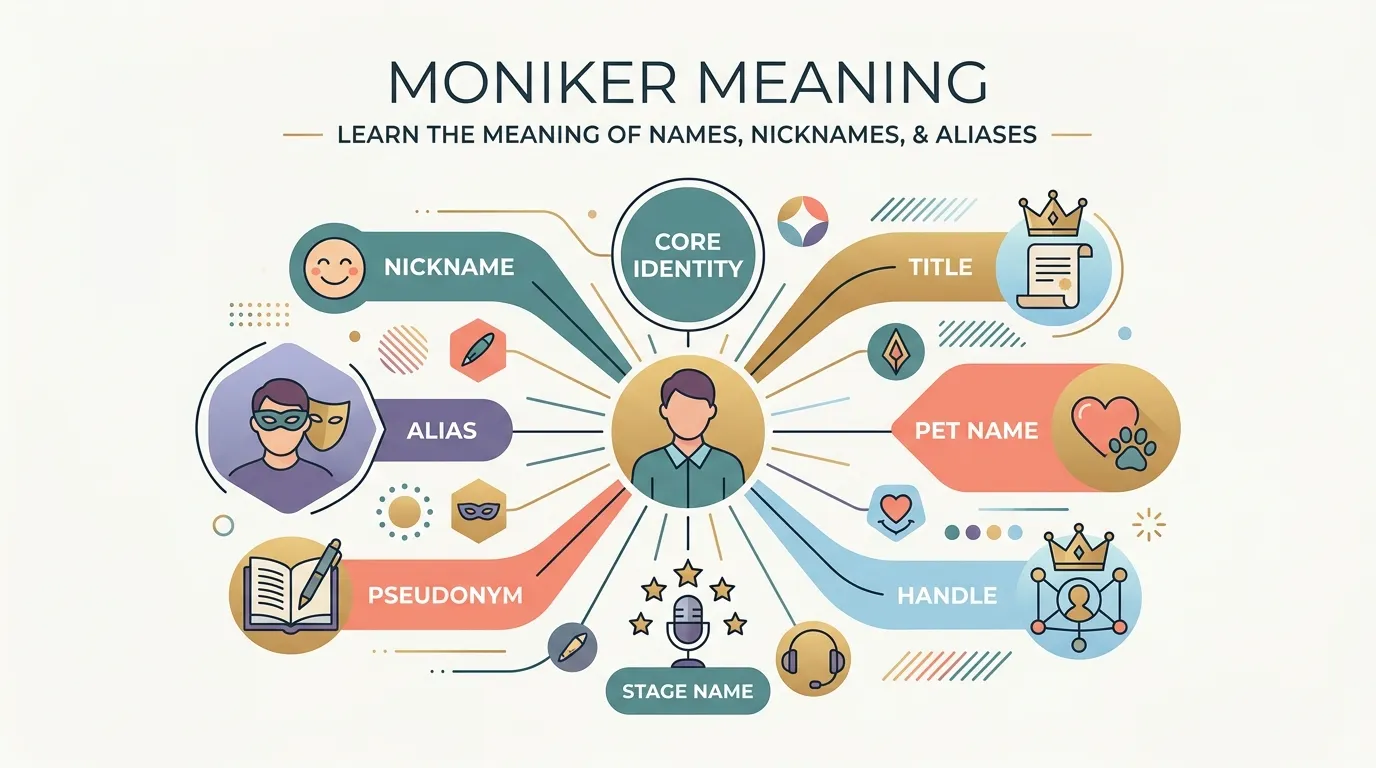
A moniker is simply a name or nickname, especially an informal one. That’s the core moniker meaning in plain terms.
In this article you’ll get a precise definition, the word’s murky but interesting history, useful synonyms, clear differences from related words, and practical examples so you can use it confidently.
What Does Moniker Mean Exactly?
A moniker is a personal name or nickname. Dictionaries describe it as informal: a name people use instead of (or in addition to) someone’s official given name. It often highlights a trait, achievement, or role.
Examples make the moniker meaning concrete:
- A football player known as The Refrigerator earned that moniker because of his size.
- Hoosier is a common moniker for someone from Indiana.
- A musician might perform under a stage moniker rather than their legal name.
The word can also refer, less commonly, to a signature. In everyday speech, though, it almost always means a nickname or handle. It carries a slightly playful or colorful tone more vivid than simply saying name.
Moniker Origin and Etymology
The moniker origin is uncertain, which is fitting for a slang term that traveled through spoken language before settling into print.
The earliest known uses appear around 1849–1851. Henry Mayhew recorded a form of the word (monekeer) in London Labour and the London Poor, describing the speech of London’s working-class and underclass communities. It was also linked early on to tramps and hobos.
Several theories try to explain where it came from:
- Many sources point to Shelta (the cryptolect of Irish Travellers), where forms like munik or munika mean name. These likely derive from Irish ainm, also meaning name.
- Another idea connects it to monk, because monks and nuns take new names, and early 19th-century British tramps sometimes referred to their life as in the monkery.
- Other suggestions include a back-slang version of the old term ekename (the ancestor of nickname) or a link to monogram, since a moniker can mean a signature.
No single explanation has won complete agreement. What is clear is that the word started as informal slang and gradually moved into wider American and British English. Today it remains informal but fully acceptable in writing and speech.
Moniker Synonym List and Related Words
When people search for a moniker synonym, these are the closest matches:
- Nickname
- Handle
- Alias
- Sobriquet (or soubriquet)
- Byname
- Cognomen
- Epithet
- Pseudonym (when the name is deliberately assumed)
Nickname is the most direct and common synonym. Handle feels especially informal, like something you might hear among friends or online. Sobriquet and cognomen sound more literary. Alias often implies a name used to conceal identity, while pseudonym is typical for writers or performers.
The right choice depends on tone. In casual conversation moniker or handle works well. In formal writing you might prefer nickname or appellation.
Moniker vs Nickname: What’s the Difference?
Moniker and nickname overlap heavily, but they are not identical in feel.
| Aspect | Moniker | Nickname |
| Formality | Informal, slightly colorful | Everyday, neutral |
| Typical use | Often highlights a trait or role | Can be affectionate, descriptive, or teasing |
| Tone | Playful or journalistic | Familiar and common |
| Frequency | Less common in speech | Extremely common |
| Extra meanings | Can mean signature | Rarely used for signatures |
In practice most people treat them as interchangeable. Saying his moniker is Flash or his nickname is Flash communicates the same idea. Moniker simply adds a touch of personality or journalistic flair.
How Moniker Is Used in Real Sentences
Seeing the word in context solidifies the moniker meaning:
- She earned the moniker ‘Queen of the Court’ after dominating the tournament.
- The software goes by the moniker ‘Dark Horse’ among developers.
- What’s your moniker around here? (a casual way of asking someone’s preferred name or handle)
- The band performed under the moniker they chose in high school.
Writers often use it when referring to stage names, sports nicknames, or regional labels. It appears frequently in news and magazine writing because it feels lively without being slangy.
Practical Tips for Using the Word
- Stick to informal or semi-formal settings. In a legal document or academic paper, name or nickname is safer.
- Pair it with the actual name for clarity: John ‘The Rocket’ Smith earned that moniker in college.
- Remember pronunciation: in American English it is typically /ˈmɑnəkər/ (MAH-nuh-kuhr).
- Avoid overusing it. Like any colorful word, it loses impact if it appears in every paragraph.
FAQs
Q: Moniker synonym
A: A moniker is another word for a name, nickname, title, or label.
Q: Moniker meaning example
A: A moniker is a name or nickname, such as “The King” for a famous person.
Q: Moniker meaning in english
A: Moniker means a name or nickname used to identify a person, place, or thing.
Q: Moniker meaning french
A: In French, moniker can be translated as “surnom,” meaning a nickname or informal name.
Q: Moniker definition Oxford
A: Oxford defines moniker as a name or nickname given to a person or thing.
Q: Moniker meaning slang
A: In slang, moniker usually means someone’s nickname, alias, or informal name.
Q: Moniker meaning origin
A: Moniker originated as American slang and is believed to have emerged in the nineteenth century.
Q: Moniker pronunciation
A: Moniker is pronounced “MON-ih-ker.”
Conclusion
The moniker’s meaning is straightforward: it is an informal name or nickname, often one that captures a person’s character, role, or reputation. Its exact origin remains debated, but the strongest linguistic clues point toward Irish and Traveller speech in the mid-19th century.
You now have a clear definition, useful synonyms, the key differences from nickname, and real examples you can draw on. The next time you hear or read the word, you’ll understand exactly what it is doingand you’ll be able to use it yourself with confidence.
Discover More Post
- DTM Meaning in Text: Full Meaning & Uses
- WDYM Meaning in Text: Meaning, Uses & Examples
- PMO Meaning in Text: Full Meaning & Examples
- FYM Meaning in Text: Meaning, Uses & Examples

At Goffaws.com, we celebrate words that move, inspire, and connect us—and few voices have done that better than Maya Angelou. A poet, author, and civil rights icon, Angelou used her powerful storytelling to speak truth, courage, and compassion into the world. Her timeless wisdom reminds us that even in struggle, there is beauty; even in silence, there is power. Join us as we explore the life, legacy, and lessons of one of history’s most inspiring voices.