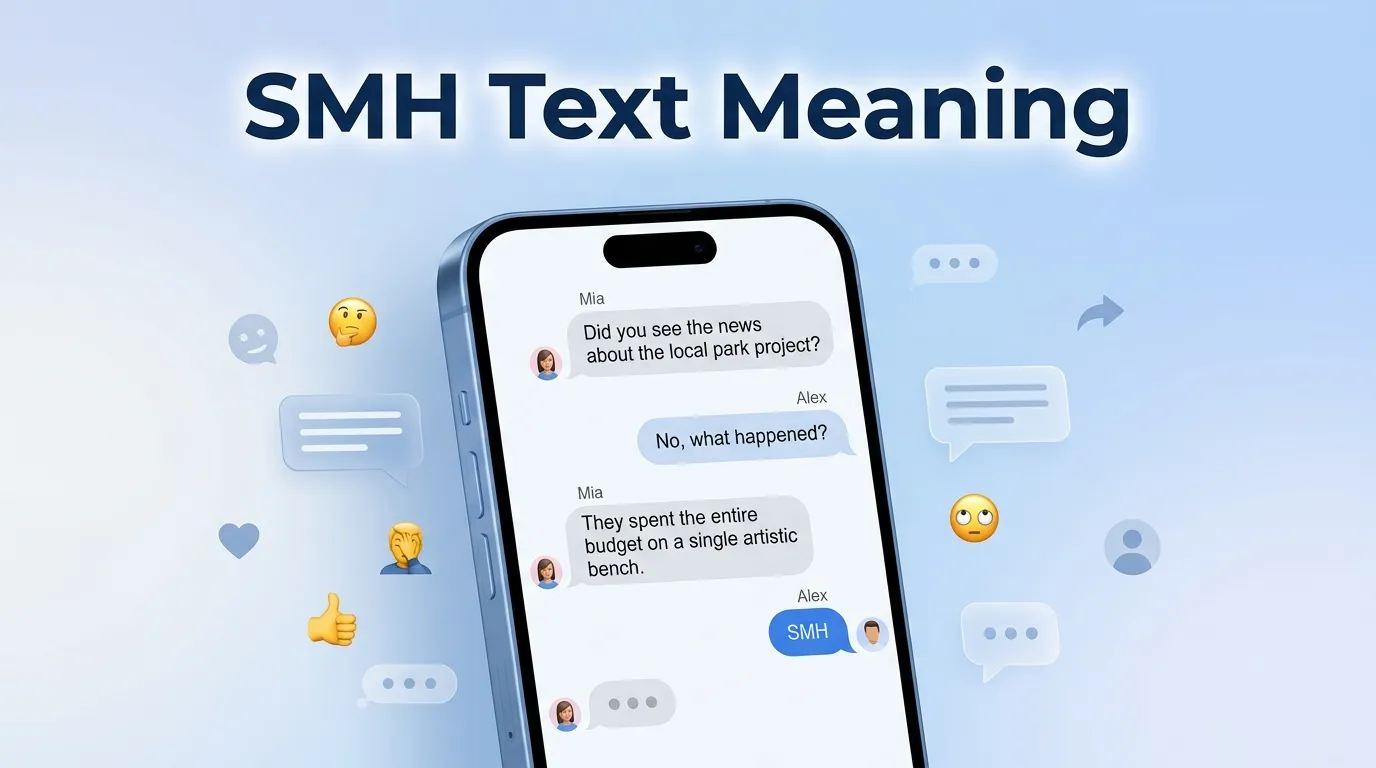
You are scrolling through a group chat, and someone replies with just three letters: smh. No sentence.
No emoji. Just smh. If you paused and thought, wait, what does that even mean? you are not alone.
Millions of people search for the smh text meaning every single day, because texting slang moves fast and it is easy to feel left behind.
SMH stands for shaking my head. People use it to show disbelief, disappointment, or mild frustration about something they just read or saw.
It is one of the most common abbreviations used in texting, social media, and online chats today.
In this article, you will learn exactly what SMH means, where it came from, how to use it correctly, common mistakes people make, and real examples from everyday conversations.
By the end, you will never have to guess what someone means by smh again.
Quick Answer
SMH means shaking my head. People type it when something surprises them in a bad way, annoys them, or makes them feel like rolling their eyes. It is a short way to react without writing a whole sentence. You will see it in texts, tweets, comments, and group chats. It can also stand for shake my head or, less often, so much hate, but the shaking-my-head meaning is by far the most common one.
Meaning or Definition
The abbreviation SMH is what people call an initialism. That means each letter stands for the first letter of a word in a phrase. In this case, S stands for shaking, M stands for my, and H stands for head.
When someone shakes their head in real life, it usually means they disagree with something, they cannot believe what just happened, or they feel let down. Typing smh online captures that exact same feeling, but in text form. It works like a stand-in for a facial expression or body language that you cannot show through a screen.
Here is a simple breakdown to help it click:
| Letter | Stands For | Purpose |
| S | Shaking | Shows movement or reaction |
| M | My | Shows it is personal, your own reaction |
| H | Head | The body part being shaken |
People often use SMH after reading something silly, hearing bad news, watching someone make a poor decision, or seeing a mistake that seemed easy to avoid. It carries a tone of I can’t believe this more than pure anger. It is usually mild, sometimes even a little playful, rather than harsh or mean.
Grammar or Correct Usage
SMH is almost always written in lowercase in casual texting, though it also appears in uppercase, especially at the start of a sentence or in formal-ish social media captions. Both smh and SMH are correct, and there is no strict grammar rule that forces one over the other.
Unlike full sentences, SMH does not need a subject or a verb attached to it. People often use it as a stand-alone reaction, similar to saying wow or ugh. It can also be added to the beginning or end of a sentence to add emotion.
Here are three common grammar patterns:
- Alone as a reaction: smh
- At the start of a sentence: smh, why would he do that
- At the end of a sentence: He forgot his own birthday, smh
Notice that SMH usually does not need a period after it, and it rarely gets capitalized like a normal word unless someone is using it to start a formal-sounding sentence. Punctuation around it is flexible, which is common with internet slang.
Origin or History
The exact birth date of SMH is hard to pin down, but language experts and internet historians generally agree it grew out of early 2000s online forums and instant messaging. Back then, texting cost money per message, and typing on early phone keypads was slow. Abbreviations like LOL, BRB, and SMH became popular because they saved time and effort.
SMH gained more visibility through platforms like AOL Instant Messenger, early forums, and later Twitter, where character limits made short phrases valuable. As texting became the normal way people communicated, especially with the rise of smartphones, SMH moved from niche internet slang into mainstream texting language used by people of nearly all ages.
Today, SMH is so widely recognized that it appears in text messages, business chats between coworkers, comment sections, memes, and even some casual news headlines. It has become part of everyday digital communication, not just something teenagers use.
Common Mistakes
Even though SMH feels simple, people misuse or misunderstand it in a few common ways. Here are the mistakes worth knowing:
Mistake 1: Confusing it with anger. SMH usually shows disappointment or disbelief, not full-blown anger. If someone is truly furious, they typically choose stronger words instead.
Mistake 2: Using it in formal writing. SMH fits casual texting and social media, but it does not belong in resumes, work emails to clients, school essays, or official documents. Using it in formal writing can seem unprofessional.
Mistake 3: Assuming it always means something negative toward the reader. Most of the time, SMH reacts to a situation or a third person’s actions, not the person you are texting. Context matters a lot here.
Mistake 4: Mixing it up with other meanings. While rare, some people use SMH to mean so much hate, especially in specific online communities. If the sentence does not make sense with shaking my head, check the context before assuming.
Mistake 5: Overusing it. Like any slang, using SMH in every single message can make texts feel repetitive or lose their impact. A little goes a long way.
Real-Life Examples
Seeing SMH in real conversations makes the meaning much clearer. Below are examples showing how people naturally use it in different situations.
| Situation | Example Text | What It Means |
| A friend is late again | He’s late again, smh | Disbelief or mild annoyance |
| Reacting to bad news | They canceled the event last minute, smh | Disappointment |
| Watching someone make a mistake | He tried to parallel park for 10 minutes, smh | Amused disbelief |
| Reacting to a silly comment | smh, that’s not even true | Disagreement |
| Personal frustration | I forgot my keys again, smh | Self-directed frustration |
You will also see SMH used in comment sections under videos or posts, often paired with an emoji like 🤦 (the face-palm emoji) to add even more emotion. On social media, people sometimes combine it with GIFs of someone literally shaking their head, which shows just how closely tied the phrase is to the physical action it describes.
In workplace chats, especially casual ones like Slack or Teams messages between coworkers who know each other well, SMH sometimes appears in a lighthearted way, such as reacting to a funny technical glitch or a scheduling mix-up.
Current Usage or Trends
SMH remains one of the most consistently used pieces of internet slang, and it shows no signs of disappearing. Unlike some slang terms that fade quickly, SMH has stayed relevant for over two decades because it fills a simple, universal need: showing disbelief without typing a full sentence.
On platforms like TikTok, Instagram, and Twitter (now X), SMH often appears in captions and comments reacting to viral videos, awkward moments, or unbelievable news stories. It pairs naturally with humor, especially when people react to fails, plot twists, or unexpected events.
Interestingly, SMH has also crossed generational lines. While it started as slang mostly used by younger internet users, older adults now use it comfortably in texts and social posts too. This shows how digital slang, once it becomes common enough, tends to blend into everyday language for nearly everyone, not just one age group.
Voice assistants and predictive texting have also helped spread its use, since many phones now recognize smh as a common phrase and suggest it automatically when typing certain sentences.
Tips or Best Practices
If you want to use SMH naturally and correctly, keep these simple tips in mind:
- Match the tone to the situation. Use SMH for mild disbelief or disappointment, not serious anger or emotional topics.
- Keep it casual. Save SMH for texts, social media, and informal chats, not professional documents.
- Don’t overuse it. Save it for moments that genuinely deserve a head-shake reaction.
- Pair it naturally. Adding a short explanation after SMH often makes your message clearer, especially with people who may not know the abbreviation well.
- Consider your audience. If you are texting someone unfamiliar with slang, such as an older relative or a new coworker, a quick explanation can prevent confusion.
Following these small habits helps SMH land the way you intend, without causing mixed signals in your conversations.
FAQs
Q: What is the SMH text meaning in WhatsApp?
A: On WhatsApp, SMH means “Shaking My Head,” expressing disappointment, disbelief, or frustration.
Q: What is SMH in WhatsApp chat?
A: In WhatsApp chats, SMH is used when someone reacts to something silly, annoying, or unbelievable.
Q: What does SMH mean dirty?
A: SMH does not have a dirty meaning by itself, though the context of a conversation may make it seem suggestive.
Q: What does SMH mean in a text from a girl?
A: When a girl texts SMH, she is usually showing disappointment, disbelief, or playful frustration.
Q: What is the SMH text meaning in chat?
A: In online chats, SMH stands for “Shaking My Head” and shows disapproval or disbelief.
Q: What does SMH mean in a text from a guy?
A: When a guy uses SMH, it typically means he finds something disappointing, ridiculous, or frustrating.
Q: What is the SMH meaning on TikTok?
A: On TikTok, SMH is commonly used in captions and comments to react to funny, shocking, or foolish content.
Q: What does SMH mean on social media?
A: Across social media platforms, SMH means “Shaking My Head” and expresses disbelief, disappointment, or disapproval.
Conclusion
At its core, the smh text meaning comes down to one simple idea: shaking my head because something feels surprising, disappointing, or hard to believe. It is a quick, casual way to react without needing a full sentence or explanation. Whether you see it in a text from a friend, a comment under a video, or a caption on social media, you now know exactly what it means and how naturally people use it.
The best way to use SMH yourself is to save it for genuine moments of disbelief, keep it casual, and avoid overusing it so it keeps its impact. Slang like this changes fast, but SMH has stuck around for a reason. It is simple, relatable, and easy for almost anyone to understand once you know the meaning behind the letters.
Discover More Post
- What Is IK Full Form? Complete Guide
- DTF Slang Meaning? The Complete Guide to DTF Slang Meaning
- What Does ATP in Chat Mean? Full Guide
- IFYKYK Meaning: What It Really Means and How to Use It

At goffaws.com, we believe laughter is as vital as a strong core. Much like Harper Lee’s gift for finding humor and truth in the everyday, we’re here to celebrate the lighter side of fitness. These CrossFit puns and jokes remind us that strength isn’t only measured in reps or rounds—it’s also in the ability to laugh through the burn. So lace up, grab your barbell, and get ready to lift your spirits as high as your next personal best.