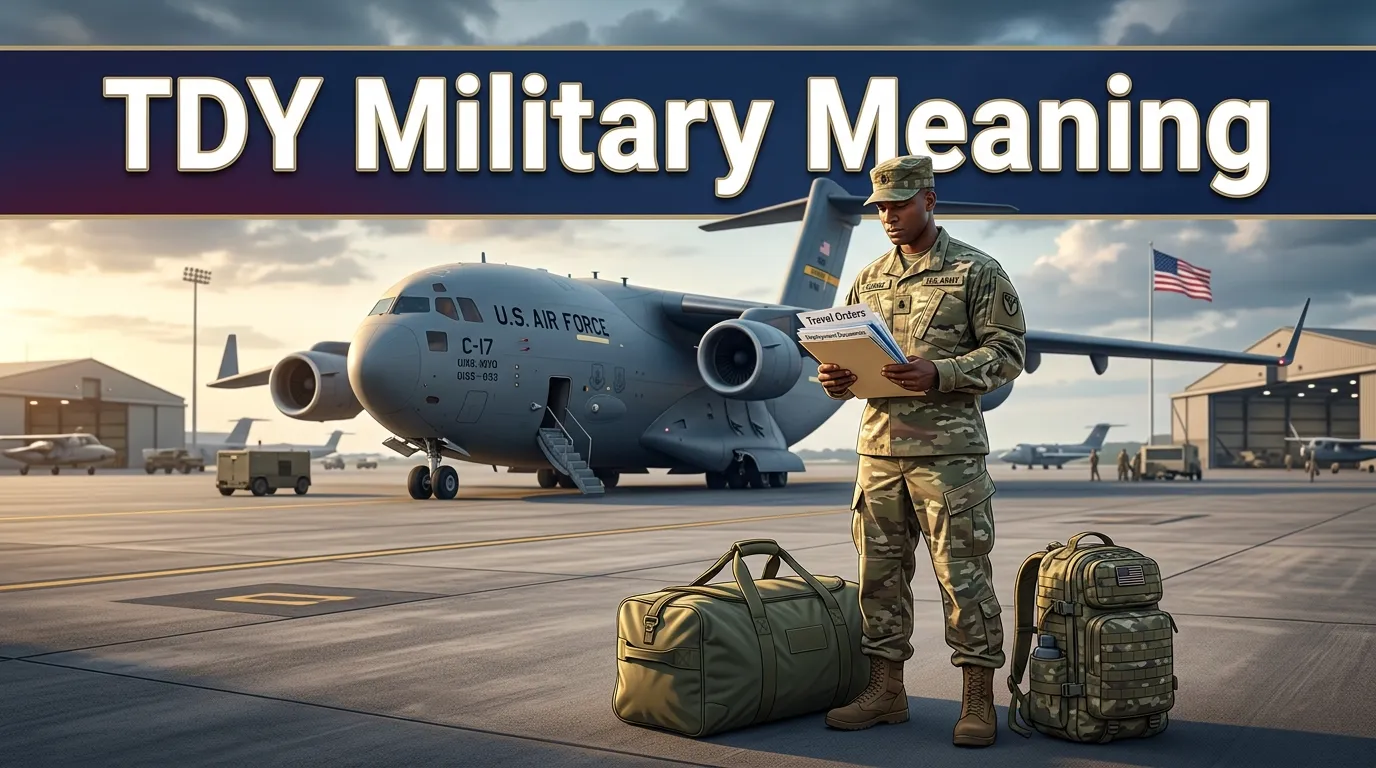
If you have ever heard a soldier say, I’m heading out on TDY next week, you might have wondered what that word even means.
The TDY military meaning is simple: TDY stands for Temporary Duty. It is when a service member gets sent to work at a different location for a short time, and then returns to their home base once the job is done.
People search for this term because military letters, orders, and family conversations use it all the time, and it can sound confusing if you have never been part of that world.
In this article, you will learn exactly what TDY means, how it is used, how it differs from other military terms, and what life looks like for someone on a TDY assignment.
Quick Answer
TDY means Temporary Duty. It describes a short military assignment away from a service member’s normal duty station. The trip could last a few days, a few weeks, or a few months, but it is always meant to be temporary. Once the mission, training, or task is finished, the service member goes back to their regular unit and job.
Meaning or Definition
In the simplest words, TDY is a short-term work trip for someone in the military. Think of it like when a civilian employee gets sent to another city for a work conference or a special project. The person still has their regular job waiting for them back home, but for now, they are somewhere else doing a specific task.
The military uses TDY orders to send people to training courses, schools, meetings, medical appointments, special missions, or other short jobs. These orders come from official paperwork that says where the person is going, why they are going, and how long they will be there. The key idea behind TDY is that it is not permanent. A service member does not pack up their whole life and move their family. They usually go alone, complete the task, and then head back to their usual post.
Some people also jokingly say TDY stands for Temporary Duty Yonder, which just means duty somewhere else for a while. That version is not the official meaning, but it is a fun way many troops remember it.
TDY vs Other Military Terms
Military life is full of short codes and abbreviations, and TDY often gets mixed up with a few other terms. Here is a simple table that shows how TDY compares to some similar military words.
| Term | Full Meaning | What It Means |
| TDY | Temporary Duty | A short trip to another location for work, training, or a mission |
| PCS | Permanent Change of Station | A full, long-term move to a new duty station, often with family |
| TAD | Temporary Additional Duty | Used mostly by the Navy and Marine Corps; same idea as TDY |
| Deployment | Deployment | Being sent to a combat zone or overseas mission, often for many months |
| Leave | Leave | Approved time off from duty, similar to vacation |
As you can see, TDY is short and temporary, while PCS is a full move. TAD is basically the Navy and Marine Corps version of TDY, just with a different name. Knowing these differences helps family members and new recruits understand military paperwork much faster.
Grammar or Correct Usage
TDY is used as a noun and sometimes as an adjective in military speech. Here are a few common ways people use it correctly:
People often say a service member is on TDY, meaning they are currently on a temporary assignment. Someone might also say they are going TDY to a certain base, which means they are traveling there for temporary work. You will also hear the phrase TDY orders, which are the official documents that explain the assignment details.
It is written in all capital letters because it is an abbreviation, not a regular word. You do not need periods between the letters. Writing it as T.D.Y. is considered outdated and is rarely used in modern military documents.
Origin or History
The term TDY has been used by the United States military for many decades. It grew out of the need to separate short trips from full station moves. Before formal systems existed, commanders would simply send troops wherever they were needed, but as the military grew larger and more organized, especially after World War II, official categories like TDY became necessary. This allowed the government to track travel costs, pay allowances correctly, and plan missions with clear timelines. Today, TDY remains one of the most common terms across the Army, Air Force, Space Force, and other branches, even though the Navy and Marine Corps often use the similar term TAD instead.
Real-Life Examples
Understanding TDY becomes much easier with real examples. Imagine an Army sergeant stationed in Texas who gets ordered to attend a two-week leadership course in Georgia. That trip is a TDY assignment. She will fly out, complete the course, and return to her unit in Texas once it ends.
Another example is an Air Force technician who gets sent to a base in another state to help repair equipment for a short project. He might be gone for ten days, staying in a hotel and receiving a daily allowance for meals, before flying back home.
A third example involves a service member sent to a military hospital for testing or specialized medical care that is not available at their home base. Even though it involves health matters, it is still classified as TDY because the trip is short and the person returns once treatment is finished.
These situations show that TDY covers many different reasons for travel, not just one specific job type. Training, repairs, medical needs, meetings, and special missions can all fall under this category.
Pay, Benefits, and Life During TDY
When someone goes on TDY, the military usually covers their travel costs, lodging, and a daily food allowance known as per diem. This helps make sure service members do not have to pay out of pocket for work-related travel. Family members sometimes worry about how TDY affects household routines, but because it is temporary, spouses and children usually stay at the home base while the service member travels alone.
Here is a table showing common things covered during a typical TDY trip.
| TDY Support Item | What It Covers |
| Travel costs | Flights, mileage, or transportation to the TDY location |
| Lodging | Hotel or approved housing during the assignment |
| Per diem | Daily allowance for meals and small expenses |
| Orders paperwork | Official documents proving the reason and length of travel |
| Return travel | Transportation back to the home duty station |
This system helps keep things fair and organized, no matter which base or mission a service member is sent to complete.
Common Mistakes
Many people confuse TDY with PCS, thinking any military move is the same thing. But PCS involves moving your entire household, often with family, furniture, and a new address, while TDY is short and temporary with no permanent move involved. Another common mistake is assuming TDY only applies to combat-related travel. In reality, most TDY assignments are training courses, schools, conferences, or short work projects that have nothing to do with combat zones. People also sometimes misuse the term by saying deployed on TDY, which mixes up two very different concepts. Deployment is usually longer, often overseas, and can involve combat operations, while TDY is shorter and mission-specific.
Current Usage or Trends
Even with today’s technology, TDY remains a common and necessary part of military operations. Many training programs, joint exercises between branches, and specialized courses still require in-person attendance, which keeps TDY assignments frequent. Virtual training has reduced some travel needs, but hands-on skills, equipment repairs, medical consultations, and leadership development still often require physical presence. Because of this, TDY continues to be one of the most talked-about terms among service members and their families, especially when discussing schedules, pay, and time away from home.
Tips or Best Practices
If you or someone you know is preparing for a TDY assignment, a little planning goes a long way. Always read the official orders carefully, since they explain dates, locations, and requirements. It also helps to pack for the specific climate and mission type, since TDY locations can range from training bases to hospitals to overseas facilities. Keeping receipts for meals and travel expenses is smart, since these may be needed for reimbursement. Communicating with family about the expected return date can also reduce stress, especially for children who may not fully understand why a parent is away. Lastly, staying in touch with your unit back home ensures a smooth transition once the TDY assignment ends.
FAQs
Q: What does TDY mean in WhatsApp?
A: On WhatsApp, TDY usually means Temporary Duty, though its meaning depends on the conversation.
Q: What does TDY mean in texting?
A: In texting, TDY most commonly stands for Temporary Duty, especially in military-related chats.
Q: What is TDY in the Air Force military?
A: In the Air Force, TDY refers to Temporary Duty, where personnel are assigned to a location other than their permanent station.
Q: What does TDY money mean?
A: TDY money refers to the travel pay, lodging, meals, and other reimbursements provided during a Temporary Duty assignment.
Q: What does TDY mean on Instagram?
A: On Instagram, TDY usually means Temporary Duty, although it may have a different meaning based on the post or context.
Q: What does the Y in TDY stand for?
A: The Y in TDY stands for Duty, making the full term Temporary Duty.
Q: What is the difference between TDY and deployment?
A: TDY is a short-term work assignment, while a deployment is typically a longer mission with operational responsibilities.
Q: How long is a TDY assignment?
A: A TDY assignment can last from a few days to several months, depending on the mission and military requirements.
Conclusion
Understanding the TDY military meaning helps make sense of a term that shows up constantly in military life.
TDY simply means Temporary Duty, a short assignment that sends a service member away from their home base for training, missions, medical care, or special projects.
Unlike a full move, it is never meant to be permanent, and troops return home once their task is complete.
You are a military family member, a new recruit, or simply curious, knowing this term can help you follow conversations, paperwork, and schedules with much more confidence. The next time you hear someone mention TDY, you will know exactly what it means and why it matters.
Discover More Post
- What Is IK Full Form? Complete Guide
- DTF Slang Meaning? The Complete Guide to DTF Slang Meaning
- What Does ATP in Chat Mean? Full Guide
- IFYKYK Meaning: What It Really Means and How to Use It

At goffaws.com, we believe laughter is as vital as a strong core. Much like Harper Lee’s gift for finding humor and truth in the everyday, we’re here to celebrate the lighter side of fitness. These CrossFit puns and jokes remind us that strength isn’t only measured in reps or rounds—it’s also in the ability to laugh through the burn. So lace up, grab your barbell, and get ready to lift your spirits as high as your next personal best.