Ever gotten a text with a looping clip of someone doing a dramatic eye-roll, and wondered exactly what it’s called and why people love sending them?
That’s a GIF and if you’ve been asking yourself what does GIF mean in texting, you’re definitely not alone.
GIFs have become one of the most popular ways people communicate online, often replacing entire sentences with a single, perfectly timed reaction.
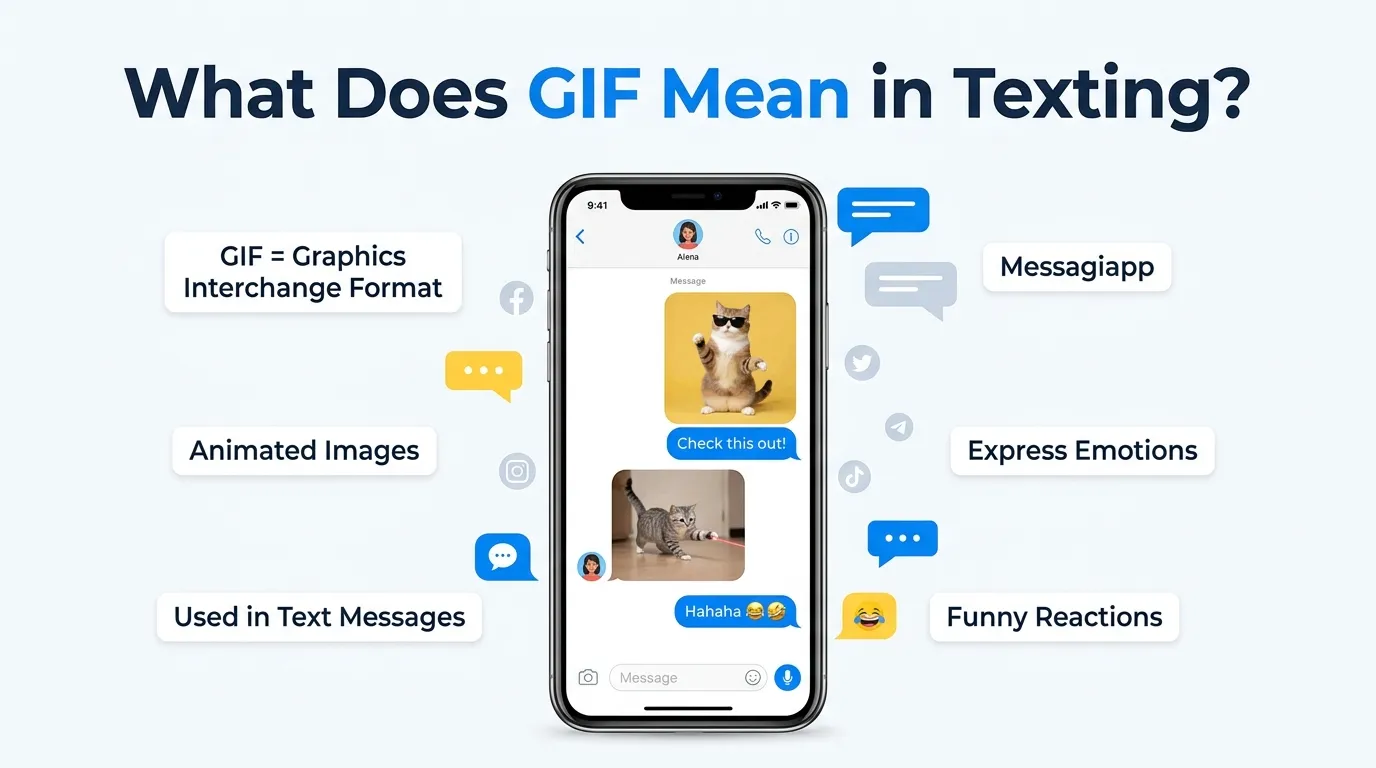
But GIF isn’t just internet slang it’s actually short for Graphics Interchange Format, a real image file type that’s been around since the late 1980s.
Somewhere along the way, it evolved from a simple way to share images into the internet’s favorite tool for humor, sarcasm, and instant emotional reactions.
In this article, we’ll break down what GIF actually stands for, how it’s used in everyday texting, the age-old pronunciation debate, and how it’s different from memes and stickers.
What GIF Stands For
GIF stands for Graphics Interchange Format. It’s a type of image file but unlike a regular photo, such as a JPEG or PNG, a GIF can hold multiple frames that play one after another in a loop. That’s what gives it the appearance of a short, silent video clip, even though it’s technically still just an image file.
The format was created back in 1987 by a team at CompuServe, led by programmer Steve Wilhite. At the time, the goal was simple: help people share images more efficiently over slow, limited internet connections. Compression was the priority, not entertainment.
Nobody involved in creating the GIF could have predicted it would eventually become the backbone of internet humor, reaction culture, and everyday texting. What started as a practical solution for early internet users has turned into one of the most expressive tools in modern digital communication decades after it was first introduced.
What does gif mean in texting from a girl
When a girl sends a GIF in a text, she is usually adding emotion or personality to the conversation. A GIF can help her show laughter, excitement, surprise, embarrassment, sarcasm, or even affection without typing a long reply. For example, a laughing GIF may mean she genuinely found your message funny, while a cute reaction may simply make the conversation feel warmer. If the GIF seems playful or flirty, it could be a sign that she feels comfortable joking with you, but one GIF cannot confirm romantic interest. Always consider the message before it, the type of GIF, and her usual texting style to understand her meaning.
What does gif mean in texting from a guy
When a guy sends a GIF in a text, it is usually a quick and expressive way to react to what you said. He may use one to show that he is laughing, surprised, excited, confused, annoyed, or joking around. A GIF can also make a short reply feel more friendly and less serious. If he sends a funny GIF after your message, he may simply be keeping the conversation entertaining. A cute, affectionate, or flirty GIF can suggest extra interest, but it does not automatically mean he likes you romantically. The best clue is the full conversation and how he normally communicates with you.
What does GIF mean in WhatsApp
On WhatsApp, a GIF is a short animated image that people send to express feelings, reactions, jokes, or ideas. Instead of typing “That is so funny,” someone might send a laughing GIF that says it for them. People also use GIFs to show excitement, confusion, surprise, love, frustration, or agreement. The meaning depends on the animation and the conversation around it. For example, a celebration GIF may show happiness about good news, while a dramatic reaction GIF may be used as a joke. GIFs are popular on WhatsApp because they make conversations more expressive while keeping replies quick, casual, and entertaining.
What does gif mean in texting funny
A funny GIF in texting usually adds humor to the conversation. Someone may send one after reading a joke, hearing a funny story, or seeing something they find ridiculous. It can also be used as a playful response when words are not enough. For example, instead of typing “I cannot believe that happened,” a person might send a dramatic reaction GIF. The meaning comes from the scene shown in the animation and the message around it. A funny GIF does not always contain a hidden message. Most of the time, it simply shows that the sender wants to laugh, react, or keep the conversation light and enjoyable.
What does GIF mean on Facebook
On Facebook, a GIF is a short animated image that can be used in comments, posts, messages, and other interactions. People often use GIFs to react to something without writing a full sentence. A laughing GIF can show amusement, while a cheering GIF may show support or excitement. Some GIFs are used as jokes, while others communicate emotions such as surprise, love, frustration, or disbelief. The meaning depends on the particular animation and the situation. Because Facebook conversations can be casual and social, GIFs are an easy way to make replies more expressive. They can turn a simple comment into something more personal and entertaining.
What does gif stand for on Instagram
GIF stands for Graphics Interchange Format. On Instagram, GIFs are commonly used as short animated images that add movement, emotion, humor, or personality to content. You may see them in Stories, messages, or other creative posts. In everyday conversation, people usually do not focus on the technical meaning of the abbreviation. Instead, they use GIFs to communicate reactions quickly. A person might add a laughing GIF to show amusement or a heart-themed GIF to make a message feel warmer. The exact meaning depends on the animation being used. Understanding the GIF itself and the surrounding conversation usually gives the clearest answer.
What does ❤ to a gif mean
A ❤ reaction to a GIF usually means the person liked or appreciated the GIF. They may have found it funny, cute, relatable, interesting, or simply enjoyable. The heart can also make the response feel warmer than a simple reaction or no reply at all. However, a heart reaction does not automatically mean romantic interest. Friends, family members, and people having casual conversations can use hearts too. If the GIF itself is romantic or affectionate, the heart may carry a stronger emotional tone. To understand the reaction correctly, look at the conversation, the relationship between you, and the way the person normally responds to your messages.
Gif meaning Urban Dictionary
People searching for GIF meaning on Urban Dictionary may be looking for informal explanations, jokes, or slang connected with GIFs. The standard meaning of GIF is Graphics Interchange Format, a digital image format commonly used for short animations. In texting and social media, a GIF usually works as a visual reaction rather than a slang word. Someone can use one to express laughter, excitement, sarcasm, surprise, frustration, or affection. Informal websites may contain unusual user-created meanings, but those definitions are not always widely accepted. If you want to understand a GIF someone sent you, the animation and the surrounding conversation are usually more useful than a random slang definition.
How GIF Is Used in Texting
In everyday conversations, GIF usually doesn’t refer to the technical file format at all it refers to the short, looping clip itself. People send GIFs for a variety of reasons, and each one serves a slightly different purpose in a conversation.
One of the most common uses is reacting to a message. Instead of typing out lol or that’s wild, a GIF can capture the exact reaction in a single glance. GIFs are also great for expressing emotions that are hard to put into words excitement, sarcasm, shock, or joy often come through more clearly in a GIF than in plain text or even emojis.
Beyond reactions, GIFs add humor to a conversation, especially since many come from iconic movie, TV, or meme moments that carry built-in comedic context. They’re also useful for keeping things light, helping break up a serious or heavy conversation with something fun and relatable.
How to Pronounce GIF
This might be one of the internet’s longest-running debates: is it pronounced with a hard G, like gift without the T, or a soft G, like jif, similar to the peanut butter brand? Believe it or not, people have strong opinions on this, and the disagreement has been going on for decades.
Steve Wilhite, the programmer who created the GIF format, has stated more than once that he intended it to be pronounced jif. According to him, the soft G pronunciation was deliberate from the very beginning. However, plenty of people including many tech professionals and everyday users pronounce it with a hard G instead, arguing that the acronym’s first letter (Graphics) supports that version.
Today, major dictionaries list both pronunciations as acceptable, meaning there’s no single correct answer. Whichever way you say it, you likely have plenty of people on your side and just as many ready to disagree.
GIF vs. Meme vs. Sticker: What’s the Difference?
Since these terms are often used interchangeably, it helps to understand what actually sets them apart, especially since each one shows up constantly in texting and social media.
A GIF is a short, looping animated clip, usually without sound, made up of multiple image frames played in sequence. It’s built for quick, repeatable visual reactions.
A meme is typically a single image, often paired with text, used to convey a relatable joke or cultural reference. Memes can be GIFs, but they don’t have to be a meme is more about the concept or joke than the file format itself. Not all GIFs are memes, and not all memes are GIFs.
A sticker is a static or animated image, often with a transparent background, designed to be layered directly onto a message. Stickers are especially common on apps like WhatsApp and Telegram, where they function more like digital emojis than reaction clips.
Why GIFs Became So Popular in Texting
Text alone can be tricky when it comes to tone. Sarcasm, excitement, humor, and even mild annoyance don’t always translate clearly through plain words, and messages can easily be misread without the right context. GIFs help fill that gap by adding a visual, emotional layer to a conversation that words alone often can’t capture.
Instead of typing out a long explanation of how you feel, a single GIF can instantly communicate reaction, tone, and personality all at once. This makes conversations feel faster, more expressive, and often more fun.
Another major factor is convenience. Most messaging apps now have GIF search built directly into the keyboard, powered by libraries like GIPHY or Tenor. This means finding the perfect reaction takes just a few seconds no need to leave the app or think too hard about the right words.
Together, these factors have made GIFs a natural, almost effortless part of how people communicate today.
The Bottom Line
So, what does GIF mean in texting? While it technically stands for Graphics Interchange Format, in everyday conversation it’s come to mean something much simpler: a short, looping animated clip used to react, express emotion, or add a bit of humor to a message.
From its humble beginnings in 1987 as a practical way to share images online, the GIF has transformed into one of the most expressive tools in modern digital communication. It fills the gaps that plain text often leaves behind, letting people convey tone, personality, and reaction in an instant.
Whether you pronounce it with a hard G or a soft G, one thing is clear GIFs aren’t going anywhere anytime soon. They’ve become a built-in part of how we text, chat, and express ourselves online, offering a quick and fun way to say exactly what words sometimes can’t.
Next time someone sends you a perfectly timed GIF, you’ll know exactly what it means and maybe even the story behind it.
FAQs
What does it mean when someone sends you a GIF?
It usually means they’re reacting to something you said, expressing an emotion, or adding humor to the conversation without typing out a full response.
Is GIF pronounced with a hard G or soft G?
Both are considered acceptable. The creator intended jif (soft G), but many people say gif (hard G), and major dictionaries recognize both.
What’s the difference between a GIF and a meme?
A GIF is a looping animated clip, while a meme is a joke or cultural reference that can appear as an image or a GIF. They often overlap but aren’t the same thing.
Why are GIFs so popular in texting?
They convey tone and emotion faster than text, and built-in GIF search in messaging apps makes them quick and easy to send.
Who invented the GIF?
Programmer Steve Wilhite created the GIF format in 1987 while working at CompuServe.
Conclusion
GIFs have grown from a simple image format into one of texting’s most expressive tools. They let people react, express emotion, and add humor in seconds something plain text often struggles to do.
You’re sending a celebratory dance clip or a sarcastic eye-roll, GIFs help conversations feel more human and alive.
And now that you know what GIF actually stands for, how it’s used, and why the pronunciation debate refuses to die, you’re fully equipped to use them with confidence in your next chat.
Discover More Articles
- FR in Chat: Full Meaning & Examples
- FS Meaning: The Complete Guide for Beginners
- What Does WYLL Mean? Complete Guide
- What Is Wyll Mean? Complete Meaning in Chat & Text

As Mark Twain once said, “The human race has only one really effective weapon, and that is laughter.” At Goffaws.com, we couldn’t agree more—especially when it comes to CrossFit puns and jokes. Fitness may be about strength and endurance, but a good laugh can be the best workout of all. From playful gym humor to clever word twists that would make Twain chuckle, we’re here to prove that comedy and conditioning are the perfect pair.