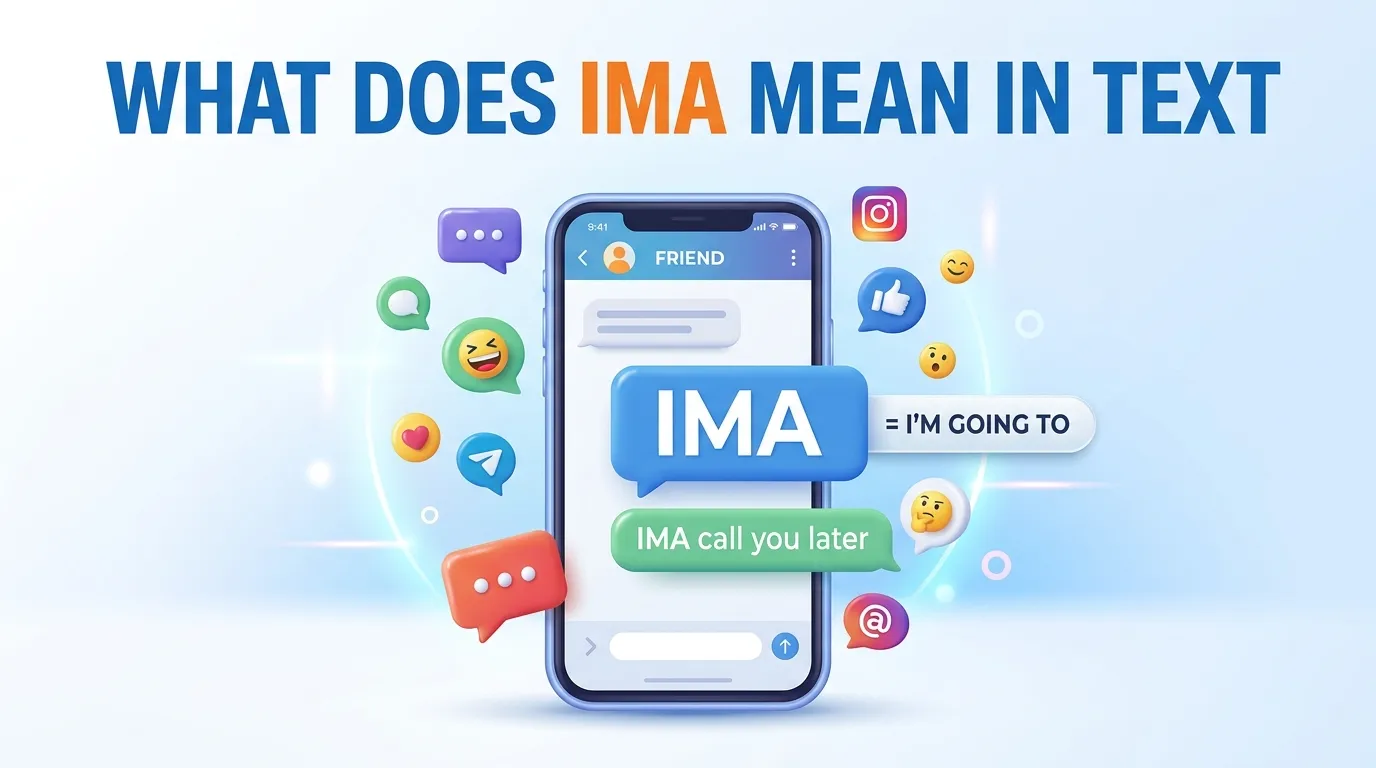
Ima is a short way to say I’m going to or I’m gonna. People use it in texts, DMs, and social media to talk about something they plan to do soon.
It’s casual, fast, and very common in everyday chat.
If a friend texts you ima call you later, they simply mean I’m going to call you later. That’s it. No hidden meaning, no confusion once you know the trick behind it.
This word shows up everywhere online, from Instagram comments to group chats with friends.
If you’ve ever paused mid-scroll wondering what someone meant, you’re not alone. This guide breaks it down in plain, simple terms so you never have to guess again.
The Simple Definition of Ima
Ima is a contraction. That means two or more words got squished together to save time and typing space.
Here’s the breakdown:
- I’m + going to → Ima
People drop the going to sound and blend it into one quick word. It works the same way gonna replaces going to or wanna replaces want to.
So when someone types ima eat, they mean I’m going to eat. When they type ima head out, they mean I’m going to head out.
Where Does Ima Come From?
Ima grew out of African American Vernacular English (AAVE), a dialect with its own grammar rules and rich history. AAVE has shaped a huge part of modern American slang, music, and internet language.
Words like finna (fixing to), tryna (trying to), and ima (I’m going to) all follow the same pattern. They shorten common phrases into faster, smoother sounds for casual speech.
Over time, texting and social media spread ima far beyond its original roots. Now people from all backgrounds use it in casual writing, especially younger generations who grew up chatting online.
How to Use Ima in a Sentence
Using ima is easy once you see it in action. It always replaces I’m going to or I’m gonna in a relaxed, spoken-style sentence.
Here are some natural examples:
- Ima head to bed early tonight.
- Ima text you when I land.
- Ima need you to send that file.
- Ima be there in ten minutes.
- Ima try that new coffee shop.
Notice something important: ima is always followed by a verb, like head, text, need, be, or try. It never stands alone.
Ima vs I’m Going To: Quick Comparison
Some people wonder if there’s a real difference between the short and long versions. There is, but it’s mostly about tone and setting, not meaning.
| Feature | Ima | I’m going to |
| Tone | Casual, relaxed | Formal or neutral |
| Best used in | Texts, DMs, social posts | Emails, essays, work chats |
| Speed to type | Fast, one word | Slower, three words |
| Common setting | Friends, family, informal chat | School, job, official writing |
| Grammar acceptance | Slang, not standard grammar | Standard, grammatically correct |
Both phrases mean the exact same thing. The only real difference is where and with whom you use them.
Common Mistakes People Make With Ima
Even simple slang can trip people up, especially if English isn’t your first language or you’re new to texting culture. Here are the most common mix-ups.
Mistake 1: Using it in formal writing. Ima doesn’t belong in a resume, a work email, or a school essay. It reads as too casual and can seem unprofessional.
Mistake 2: Confusing it with a name. Ima is also a real first name in some cultures, particularly Japanese and Hebrew backgrounds. Context matters. Ima is coming over could mean a person named Ima, not I am going to.
Mistake 3: Overusing it with strangers. Texting a new coworker or someone you just met? Stick to full words until you know their communication style.
Mistake 4: Misspelling related slang. Some people confuse ima with imma, i’ma, or I’ma. These are all just spelling variations of the same word, so don’t stress over the exact spelling.
Mistakes vs Correct Usage Table
| Situation | Common Mistake | Correct Way |
| Work email | Ima send the report | I’m going to send the report |
| Texting a friend | Avoiding slang entirely | Ima call you tonight is fine |
| Talking about a person named Ima | Reading it as slang | Check context clues first |
| School essay | Using ima for style | Use I am going to or I will |
| Group chat with peers | Overthinking spelling | Ima, imma, and i’ma all work |
When Should You Use Ima?
Think of ima like flip-flops. Great for the beach, not so great for a job interview. The same goes for texting.
Use ima when:
- You’re texting close friends or family
- You’re commenting on social media
- You’re writing in a relaxed group chat
- You want your message to feel warm and casual
Skip ima when:
- You’re emailing a boss, teacher, or client
- You’re writing something official or public
- You don’t know the other person well
- The setting calls for clear, formal English
Reading the room matters more than the word itself. The same message can feel friendly in one chat and out of place in another.
Quick Reference Checklist
| Check This | Yes or No |
| Am I texting a friend or family member? | ✅ Use ima |
| Is this a work or school message? | ❌ Use I’m going to |
| Does the sentence need a verb after ima? | ✅ Always required |
| Could Ima be a person’s name here? | ⚠️ Check context first |
| Am I unsure how casual to be? | ❌ Play it safe, spell it out |
Ima in Pop Culture and Music
You’ll hear ima constantly in song lyrics, especially in hip-hop, R&B, and pop music. Artists use it to keep lyrics sounding natural and conversational, matching how people actually talk.
It also shows up heavily in memes, captions, and viral posts. Because it feels casual and rhythmic, it fits perfectly into short-form content like TikTok captions or tweet threads.
This wide use in music and online culture is a big reason ima spread so quickly across the internet, reaching people who might never have encountered AAVE roots directly.
FAQs
Q: What does IMA mean on Instagram?
A: On Instagram IMA usually means I am going to or I am about to do something.
Q: What does IMA mean on Snapchat?
A: On Snapchat IMA is a casual way of saying I am going to before an action.
Q: What does IMA mean in Hebrew?
A: In Hebrew Ima means mother and is a common word used to call or refer to a mom.
Q: Does Ima mean mom?
A: Yes Ima means mom or mother in Hebrew.
Q: What is Ima in Urban Dictionary?
A: Urban Dictionary commonly defines IMA as slang for I am going to.
Q: What does Ima mean in Arabic?
A: In Arabic Ima can have different meanings depending on the spelling and context so there is no single definition.
Q: What is the IMA meaning in medical?
A: In medical terms IMA most commonly stands for Internal Mammary Artery.
Q: What is the Ima meaning in English?
A: In English IMA is usually an informal spelling of I am going to used in casual conversations.
Conclusion
Ima is simply a fast, casual way to say I’m going to. It’s not slang to fear or avoid understanding, it’s just part of how modern texting works.
Once you know the pattern, you’ll spot it everywhere: in texts, captions, lyrics, and comments. The key is knowing your audience. Save it for friends, family, and relaxed chats, and switch back to full sentences for anything formal.
Texting language changes fast, but the goal stays the same: clear, easy communication. Now that you know what ima means, you can read it, use it, and reply to it with total confidence.
Discover More Post
- Tsk Tsk Meaning: What It Really Means
- Lght Mean: Definition, Uses & Examples
- HMU Means: Definition, Uses, and Examples
- What Does WBU Mean in Text? Full Meaning & Examples

At goffaws.com, we believe laughter is as vital as a strong core. Much like Harper Lee’s gift for finding humor and truth in the everyday, we’re here to celebrate the lighter side of fitness. These CrossFit puns and jokes remind us that strength isn’t only measured in reps or rounds—it’s also in the ability to laugh through the burn. So lace up, grab your barbell, and get ready to lift your spirits as high as your next personal best.