If you have ever texted a friend and gotten back a short reply like idc, you pick, you might have paused for a second. What does that even mean?
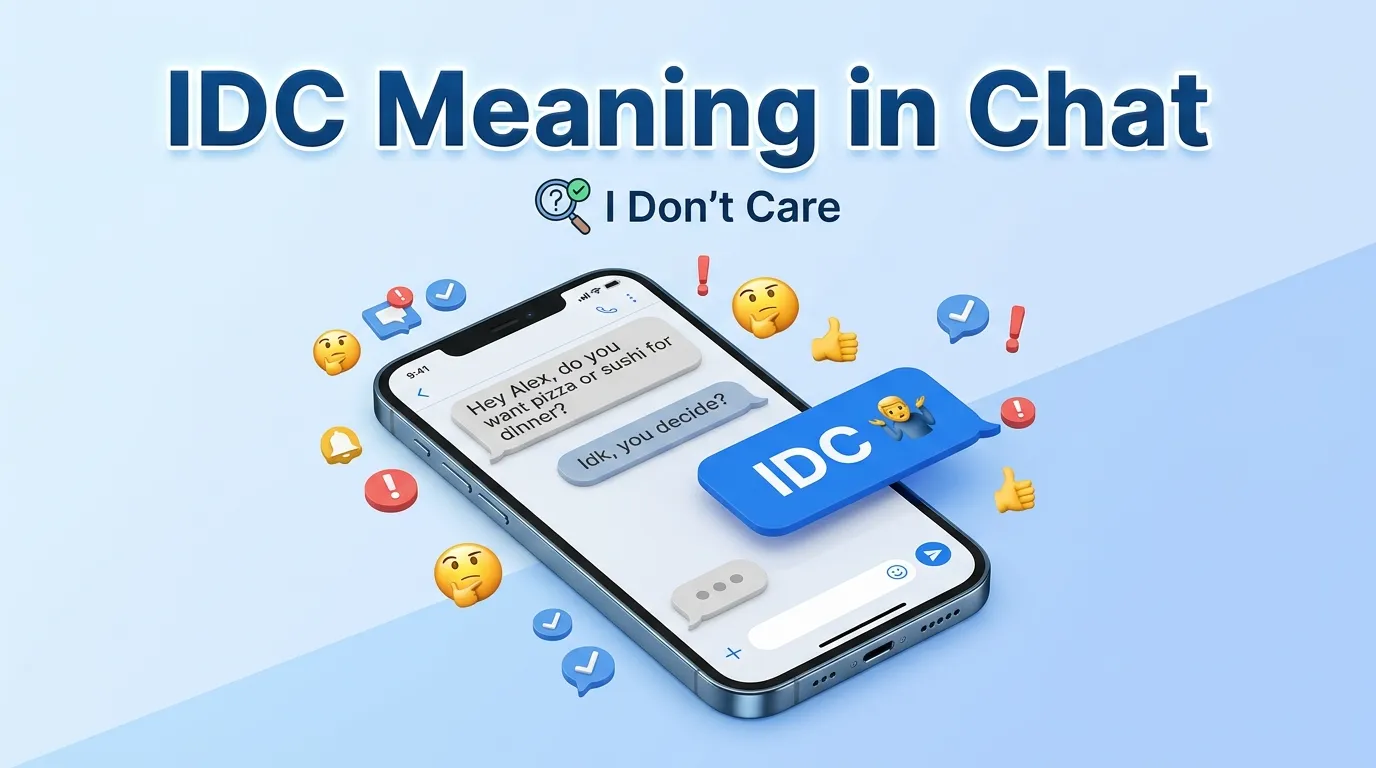
The idc meaning in chat is simple: it stands for I don’t care. People use it to say they have no strong opinion about something, or that a topic does not bother them much.
It is one of the most common short forms used in texting, gaming chats, and social media comments today.
This little abbreviation shows up everywhere, from group chats planning dinner to comment sections on YouTube. But even though it looks simple, it can be used in different ways, and the tone behind it changes a lot depending on the situation.
Some people use it to sound relaxed and easygoing. Others use it when they are annoyed or upset.
In this article, you will learn exactly what idc means, how to use it correctly, when to avoid it, and how it compares to similar chat abbreviations like idk and idgaf.
Quick Answer
IDC stands for I don’t care. People type it when they want to show they have no preference, no strong feeling, or no interest in a topic being discussed. It is casual, quick, and mostly used in texting or online chatting rather than in formal writing.
For example, if someone asks, Pizza or burgers tonight? a reply of idc, both sound good simply means the person is fine with either choice. It is not always a sign of rudeness. Often, it is just a fast way to say I’m easy or you choose.
Meaning or Definition
The phrase I don’t care has existed for a very long time in spoken English. When texting became popular in the late 1990s and early 2000s, people started shortening common phrases to save time and effort while typing on small keyboards. IDC became one of those shortcuts.
At its core, idc expresses a lack of preference or a lack of strong emotional reaction. It can mean:
- I have no opinion, you decide.
- This topic does not matter to me.
- I’m not bothered by this situation.
- I’m annoyed, and I’m shutting the conversation down.
The exact meaning almost always depends on the context around it. A single reply like idc without any other words can feel a bit cold or dismissive. But when it is paired with more explanation, such as idc what people think, I’m wearing what I like, it comes across as confident and easygoing instead.
It’s also worth noting that idc is considered internet slang, not standard English. You will not find it in a dictionary as a formal word, though many online slang dictionaries and chat guides do explain its meaning because it is used so widely.
Grammar or Correct Usage
IDC works like a short sentence on its own. It usually replaces the full phrase I don’t care in a message. Because it already includes a subject (I) and a verb phrase (don’t care), you generally do not need to add extra words before it.
Here are some grammar-friendly ways people use idc in real conversations:
- As a standalone reply: idc
- Followed by a reason: idc, I’m just tired today
- Before a statement: idc what he thinks, I did my best
- Combined with other slang: idc tbh (I don’t care, to be honest)
Since idc is informal, it does not follow strict grammar rules the way a formal sentence would. People often skip capital letters and punctuation completely when typing it. Writing IDC in all capital letters can sometimes come across as shouting or as extra emphasis, so most people simply type it in lowercase.
One common mistake is trying to use idc in essays, emails to a teacher, or workplace messages. Because it is slang, it does not fit in professional or academic writing. In those settings, it is better to write out the full phrase, such as I don’t have a strong preference or I’m open to either option.
Origin or History
Short forms like idc grew out of early internet chat rooms and instant messaging apps in the 1990s. Programs like AOL Instant Messenger (AIM) and early mobile texting had character limits or slow typing speeds, so users invented abbreviations to communicate faster. Phrases like brb (be right back), lol (laugh out loud), and idc (I don’t care) all came from this same need for speed.
As texting became the main way many people communicated, especially teenagers and young adults, these abbreviations spread quickly. Social media platforms like Twitter, and later Instagram and TikTok, helped keep this kind of shorthand alive because posts and comments often have limited space or reward quick, punchy replies.
Today, idc is considered a well-established piece of internet slang. It is widely recognized across English-speaking countries, though it is used slightly more often by younger generations who grew up texting regularly.
Common Mistakes
People sometimes misuse or misunderstand idc in chat. Here are a few common mix-ups worth knowing about.
| Mistake | Why It Happens | Better Approach |
| Using idc in professional emails | Confusing casual chat habits with workplace tone | Write I don’t have a preference instead |
| Assuming idc always means anger | Tone is hard to read in text | Look at the full message and past conversation for context |
| Confusing idc with idk | Both start with id and look similar | Remember idc means I don’t care, idk means I don’t know |
| Typing IDC in all caps during a calm chat | Caps can look like shouting online | Use lowercase for a neutral, relaxed tone |
| Sending only idc with no explanation | Can seem dismissive or rude | Add a short reason to soften the reply |
A big part of using idc well is understanding that texting removes tone of voice and facial expressions. The same three letters can feel friendly or harsh depending on who sends them, the relationship between the people chatting, and what came before in the conversation.
Real-Life Examples
Seeing idc in real conversation examples makes its meaning much clearer. Below are a few common situations where it pops up.
Example 1: Deciding on plans Friend: Movies or bowling tonight? You: idc, either is fun for me! Here, idc shows flexibility, not disinterest.
Example 2: Responding to gossip Friend: Did you hear what she said about you? You: idc honestly, not worth my energy. In this case, idc shows the person is choosing not to be bothered by drama.
Example 3: Group chat decision Group member: What time should we meet up? You: idc, whatever works for everyone else. This use shows the speaker trusts the group to decide.
Example 4: A slightly annoyed tone Parent: You need to clean your room today. Teen: idc, I’ll do it later. Here, the tone shifts. It can sound a bit dismissive or pushback-y, especially without more context.
Example 5: Gaming chat Teammate: You want to play this map or the other one? You: idc lol, both are good. Gaming chats use idc constantly since decisions need to happen fast.
These examples show that idc is a flexible phrase. Reading the whole sentence, not just the abbreviation, helps you understand the real feeling behind it.
IDC Meaning in Chat and Text
IDC means “I Don’t Care” in chat and text messages. People use this abbreviation when they want to show that something does not matter to them or they do not have a strong opinion about a topic. It is commonly used on social media platforms like Instagram Snapchat TikTok WhatsApp and Discord. The tone of IDC can be casual neutral or sometimes rude depending on the conversation. Understanding the context helps you know the person’s real intention.
What Does IDC Mean and IDC Full Form
The full form of IDC is “I Don’t Care.” It is a common internet slang abbreviation used in online conversations to save time while typing. Someone may write IDC when they are not interested in a decision or do not want to discuss a certain topic further. Although it is a simple phrase it can sound different depending on the situation. With friends it may feel relaxed but in serious conversations it may seem dismissive.
IDC Person Meaning
An IDC person usually refers to someone who appears not to care about certain opinions situations or problems. This does not always mean the person is rude because some people use this attitude to show confidence or avoid unnecessary stress. However if someone constantly says IDC during important discussions others may see them as uninterested. The meaning depends on the person’s behavior and the situation where the phrase is used.
Que Significa IDC En Chat
In Spanish conversations IDC also means “I Don’t Care” and is often used the same way as in English chats. Spanish speakers may use this abbreviation on social media messages and online platforms because many internet slang terms are shared globally. The meaning remains the same even when the conversation language changes. If you see IDC in a chat it usually shows that the person does not mind or is not concerned about something.
Current Usage or Trends
IDC remains extremely popular across texting apps, Discord servers, gaming platforms, and social media comment sections. It fits perfectly into fast-paced digital conversations where people want to reply quickly without typing a full sentence.
On platforms like TikTok and Instagram, idc sometimes appears in captions too, not just replies. For example, someone might post a photo with the caption idc what anyone thinks, I love this outfit, using it to express confidence rather than indifference.
There are also related, more intense versions of the phrase that have grown popular, especially among younger users:
| Abbreviation | Full Meaning | Common Tone |
| idc | I don’t care | Neutral to relaxed |
| idgaf | I don’t give a f*** | Strong, blunt, sometimes rude |
| ijs | I’m just saying | Adds a personal opinion softly |
| idk | I don’t know | Uncertainty, not indifference |
| nvm | Never mind | Dropping the topic entirely |
Understanding these related terms helps readers avoid mixing them up, since they can look similar in fast typing but carry very different levels of intensity.
Tips or Best Practices
Using idc well in chat is mostly about reading the room and thinking about how your message might sound to the other person. Here are some simple tips that can help.
First, think about your relationship with the person you are texting. Close friends usually understand a short idc without taking it personally. With someone you do not know well, or in a more serious conversation, it might be better to explain a little more.
Second, consider adding a short reason. Instead of just idc, try idc, I’m just happy to be there or idc, you know the area better than me. This small addition changes the entire feel of the message from flat to friendly.
Third, avoid using idc when someone is asking for real emotional support. If a friend is upset and asks for your opinion on something serious, replying with just idc can come across as uncaring, even if that is not what you meant.
Fourth, remember that idc is not appropriate for formal writing. School assignments, job applications, and professional emails should always use full sentences instead of chat slang.
Finally, pay attention to punctuation and emojis. Adding a smiley face or lol after idc, like idc lol, whatever you want, softens the tone and makes it clear you are being relaxed rather than dismissive.
FAQs
Q: Idc meaning in chat pakistan
A: IDC means I don’t care in chat and is commonly used to show a lack of interest.
Q: Idc meaning in chat in urdu
A: IDC means I don’t care which can be translated as mujhe farq nahi parta in Urdu.
Q: Idc meaning in chat whatsapp
A: IDC on WhatsApp means I don’t care and shows that someone is not concerned about something.
Q: IDC meaning Medical
A: In medical terms IDC can mean Invasive Ductal Carcinoma which is a type of breast cancer.
Q: Idc meaning in chat from a girl
A: IDC from a girl usually means I don’t care and may show she is not interested or concerned.
Q: Idc meaning in english
A: IDC means I don’t care in English and is used to express no concern.
Q: Idc meaning in email
A: IDC in an email usually means I don’t care depending on the context of the message.
Q: What does idc mean from a boy
A: IDC from a boy usually means I don’t care and shows he is not bothered about something.
Conclusion
The idc meaning in chat comes down to one simple phrase: I don’t care. It is a fast, casual way to show that you have no strong opinion, no preference, or no interest in getting worked up over something small.
While it is incredibly common in texting, gaming chats, and social media, its tone can shift from relaxed to a little sharp depending on how it is used.
The best approach is to pay attention to context. A short idc among close friends usually feels light and easy. In serious conversations, or with people you do not know well, adding a few extra words helps keep things friendly and clear.
And remember, idc belongs in casual chat, not in schoolwork or professional messages. Once you understand these small details, using idc in your own conversations becomes simple and natural.
Discover More Articles
- IYKYK Mean? Everything You Need to Know
- OFC Mean? Complete Guide
- What Does TH Mean? Full Meaning Explained
- What Is OFC Mean? Simple Guide With Real Examples

As Mark Twain once said, “The human race has only one really effective weapon, and that is laughter.” At Goffaws.com, we couldn’t agree more—especially when it comes to CrossFit puns and jokes. Fitness may be about strength and endurance, but a good laugh can be the best workout of all. From playful gym humor to clever word twists that would make Twain chuckle, we’re here to prove that comedy and conditioning are the perfect pair.