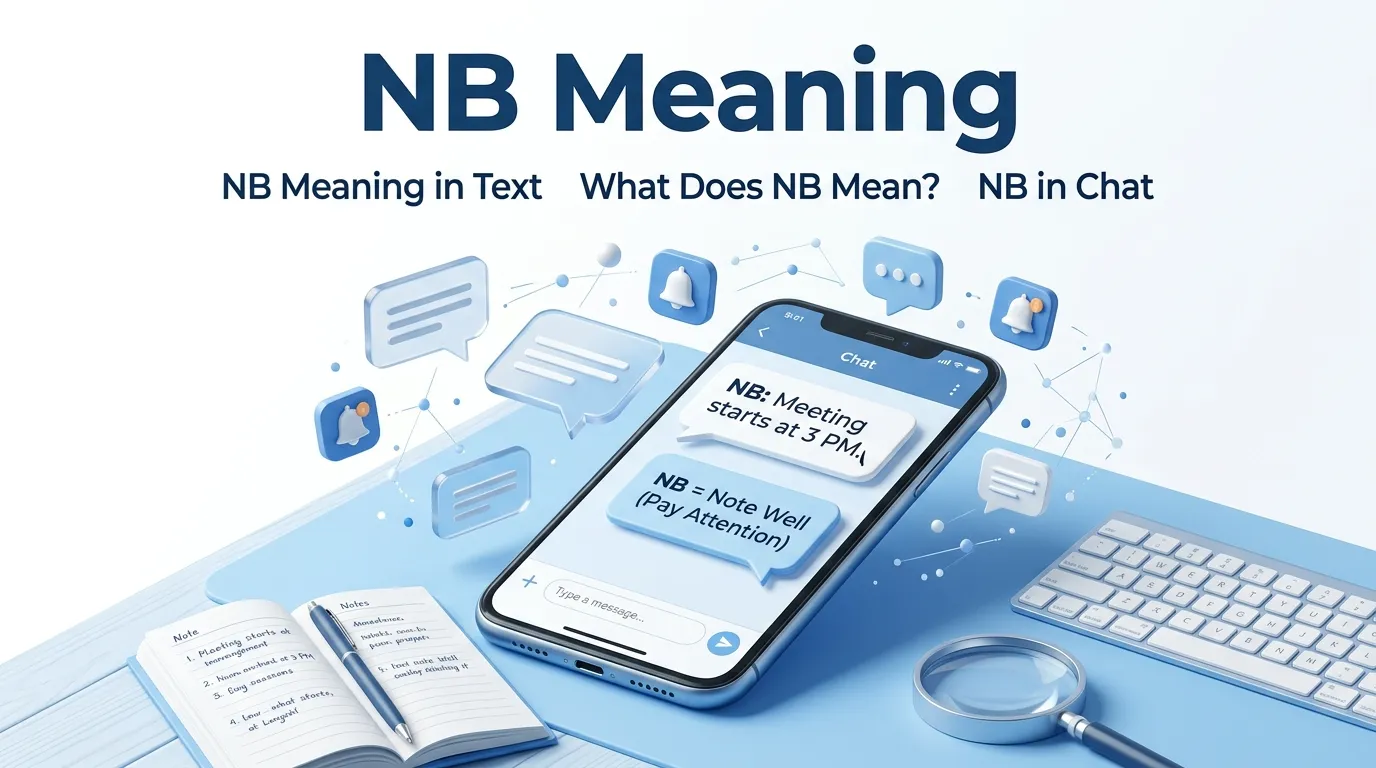
If you have ever seen the letters NB at the start of a sentence, in an email, or on someone’s social media bio, you have probably paused and wondered what it means.
The short answer is that NB most often stands for nota bene, a Latin phrase meaning note well. But that is not the only meaning.
NB can also stand for non-binary when talking about gender identity, and it has a few other meanings too, depending on where you see it.
This guide breaks down every common meaning of NB, shows you how to use it correctly, and clears up the mix-ups people run into most.
Quick Answer
NB usually means nota bene, a Latin term that means note well or pay attention. Writers use it to flag something important that the reader should not skip over. In a completely different context, NB can also mean non-binary, a gender identity outside the male-female binary. The correct meaning always depends on where and how the letters are used.
What Does NB Mean?
If you are searching what does NB mean or NB meaning, the abbreviation can have different meanings depending on the context. In general writing, NB stands for “Nota Bene,” a Latin phrase meaning “note well” or “pay attention.” People use it to highlight important information. In texting and online conversations, NB may also have different meanings based on the community or topic. Understanding the situation where NB appears is important to know the correct meaning.
NB Meaning in Text
The NB meaning in text depends on how it is used in a conversation. In many cases, NB refers to “Nota Bene” when someone wants to point out an important detail. However, in casual chats and online spaces, users may use NB as a personal abbreviation or slang term. Unlike common texting abbreviations, NB does not always have one fixed meaning. Checking the full message helps you understand what the sender intends.
N.B. Meaning
The N.B. meaning is “Nota Bene,” which comes from Latin and means “note well” or “take special notice.” It is commonly used in writing, documents, books, and academic content to draw attention to important information. When you see N.B. before a sentence, it usually means the following detail deserves extra attention. Although it is not a common texting abbreviation, it is still used in formal and written communication.
Meaning or Definition
Let’s slow down and look at each major meaning of NB one at a time, since context changes everything here.
NB as Nota Bene. This is the classic, traditional meaning of NB, and it is still the one you will find in dictionaries and style guides. Writers place NB right before a sentence or note to say, in effect, Hey, pay close attention to this part. It works a lot like writing Note: or Important: before a sentence, except NB feels a bit more formal and old-fashioned.
NB as Non-Binary. In recent years, especially on social media and in casual writing about gender and identity, NB (sometimes written as enby, which is how you say the letters N and B out loud) refers to someone who does not identify strictly as male or female. You might see it in a bio like she/her, NB or they/them (NB).
NB as an Abbreviation for Places or Terms. NB can also stand for things like New Brunswick (a Canadian province), Nebraska (in some informal lists), or no ball in cricket scoring. These meanings are far less common than the first two, but they do show up in specific fields.
Here is a simple table to help you compare the meanings side by side.
| Meaning of NB | Field or Context | Example Sentence |
| Nota Bene (note well) | Writing, academic papers, legal notes | NB: The office closes early on Fridays. |
| Non-binary | Gender identity, social media bios | They introduced themselves as NB and use they/them pronouns. |
| New Brunswick | Canadian geography, addresses | The package was shipped from NB, Canada. |
| No ball | Cricket scoring | The umpire called NB after the bowler overstepped the line. |
| Nebraska (informal) | Casual lists, forums | She moved from NB to Texas last year. |
Origin or History
The phrase nota bene comes straight from Latin, where nota means note and bene means well. Together, they translate to note well or mark well. Scholars and writers have used this phrase for centuries, especially in academic and legal writing, as a way to highlight a point that readers should not gloss over. Because Latin was once the standard language of scholars across Europe, many Latin abbreviations, including NB, e.g., i.e., and etc., made their way into everyday English writing and simply stayed there.
The gender-related use of NB is much newer. It grew out of the broader conversation around gender identity that expanded in the 2010s, as more people began publicly identifying outside the traditional categories of male and female. The word non-binary itself describes any gender identity that does not fit neatly into man or woman, and NB became a natural short form once the term gained wider use.
Grammar or Correct Usage
Using NB correctly is simple once you know the pattern, but a few small details matter.
When using NB to mean nota bene, write it in capital letters, followed by a colon, and then your note. For example: NB: Please double-check the attached figures before the meeting. You typically place it at the very start of a sentence or paragraph, never in the middle. Some older style guides add periods, like N.B., but modern American writing almost always drops the periods and simply writes NB.
When using NB to mean non-binary, it usually appears as a label, often alongside pronouns, rather than at the start of a sentence. For example: Jordan (NB, they/them) will lead the workshop. It can also stand alone, as in I identify as NB.
One more grammar note: NB is not really an English word, so it does not change form. There is no plural version, and it is not something you conjugate or use as a verb. It functions purely as a marker or a label.
Common Mistakes
People run into a handful of predictable mix-ups with NB, so let’s clear them up.
The biggest mistake is confusing which meaning applies. Because NB can mean two very different things, writers sometimes use it in a way that confuses readers. If your audience is not familiar with nota bene, writing NB without context might leave them puzzled. In more formal or academic writing, this is usually not a problem, but in casual writing, it helps to spell it out at least once.
Another common error is punctuation. Some writers add unnecessary periods, write it in lowercase mid-sentence, or forget the colon after it. While there is no single global rule, American English style guides generally favor NB: with a colon and no periods between the letters.
NB Meaning
NB can have several meanings depending on where you see it, but one common meaning is “nota bene,” a Latin phrase used to draw attention to an important point. In everyday writing, NB may appear before a note or reminder that the reader should notice. It can also have different meanings in texting, social media, business, education, and other areas. Because abbreviations often depend on context, it is important to look at the words around NB before choosing a meaning. If you saw NB in a message, caption, comment, or post, the surrounding sentence can usually tell you what the person intended.
NB Meaning in Text
NB meaning in text can depend on the conversation and the people involved. A common meaning is “nota bene,” which is used to point out something important or worth remembering. However, NB can also be used as an abbreviation for other terms in different conversations. Unlike some texting abbreviations that have one widely accepted meaning, NB is more context-dependent. If someone writes “NB: check this first,” they are likely highlighting an important note. When you see NB in a text message, read the complete sentence before deciding what it means. This helps avoid confusing one abbreviation with another.
NB Meaning in Chat
NB meaning in chat is usually understood from the context of the conversation. In some chats, NB may mean “nota bene,” especially when someone wants to emphasize an important detail or reminder. However, it can represent other words or phrases in different communities. Chat abbreviations are often shortened for convenience, so the same two letters may mean different things to different people. If someone sends “NB” followed by a reminder, instruction, or important detail, they may be asking you to pay attention. Looking at the surrounding messages is the easiest way to understand the intended meaning.
What does nb mean in email
In an email, NB usually means nota bene, a Latin phrase that means note well or take special notice. It is used to highlight information the reader should pay attention to. For example, someone might write NB: The meeting time has changed to make the update stand out. You may also see it written as N.B. with periods. The phrase is common in formal or professional writing, especially when an important detail needs extra attention. Its meaning is usually not related to texting slang. If you see NB in an email, look at the words around it to understand exactly what information the sender wants you to notice.
What is nb
NB can have several meanings, but in written messages and emails, it most commonly means nota bene, meaning note well. It is used before an important detail, reminder, warning, or clarification. For example, NB: Please bring your ID tells the reader that the information deserves special attention. In other situations, NB may stand for something completely different, depending on the subject. It can be an abbreviation, initials, or a technical term. Because of this, context matters. If you found NB in an email, letter, school document, or online message, the surrounding words can help identify the intended meaning.
What does nb stand for
NB most commonly stands for nota bene, a Latin expression meaning note well. English writers use it to draw attention to an important point or detail. You may see it before a reminder, correction, instruction, or extra piece of information. For example, NB: Applications close Friday tells the reader to pay close attention to the deadline. However, NB can have other meanings in different fields, so the context should always be considered. In everyday writing, especially emails and documents, nota bene is one of the most common meanings. It is also often written as N.B.
Nb stand for
NB stands for nota bene, which means note well or pay close attention. It is often used in emails, letters, notes, academic writing, and other written communication to highlight something important. For example, NB: The office will be closed Monday signals that the reader should notice the information that follows. The abbreviation comes from Latin but is still used in modern English writing. Depending on the context, NB can have other meanings, so it is not always safe to assume one definition. If you saw it in a specific message, the surrounding sentence can usually tell you what the writer intended.
What does nb mean in text from a girl
If a girl uses NB in a text, the meaning usually depends on the conversation. If she writes it before an important detail, such as NB: Don’t forget tomorrow, she may simply mean note well or pay attention to this. It does not automatically have a romantic, secret, or special meaning just because it comes from a girl. In casual texting, people may also use NB for other phrases or personal abbreviations. The best way to understand it is to look at the complete message and the topic being discussed. Context is much more reliable than assuming NB always means one specific thing.
Nb in email
NB in an email usually means nota bene, which translates to note well or take special notice. It is used to make an important detail stand out from the rest of the message. For example, an email might say, NB: Please submit the form before Friday. This tells the reader that the deadline deserves attention. You may see the abbreviation written as NB, N.B., or sometimes followed by a colon. It is more common in formal or professional writing than in casual emails. If an email uses NB in another context, the surrounding sentence should be checked because the abbreviation can have different meanings.
N.B. meaning
N.B. means nota bene, a Latin phrase that translates to note well. Writers use it when they want readers to pay special attention to an important fact, instruction, reminder, or exception. For example, N.B. The deadline cannot be extended and highlights the information that follows. The abbreviation is often found in emails, letters, academic work, instructions, and formal documents. Some writers use NB without periods, while others prefer N.B. Both forms generally have the same meaning. If you see N.B. in a message, it usually signals that the following information is worth noticing carefully.
NB Definition
The most traditional NB definition is “nota bene,” a Latin expression meaning “note well” or “take special notice.” It is used to highlight information that deserves attention. You may see NB in writing before an important reminder, clarification, or additional point. For example, a writer might use “NB” before mentioning a rule that readers should not overlook. The abbreviation is not limited to one field, though. It can have different definitions in areas such as education, business, technology, and online communication. Therefore, the correct definition depends on where and how NB is being used.
NB Meaning Text
The NB meaning in text can vary based on the message. One established use is “nota bene,” which tells the reader to pay particular attention to the information that follows. For example, “NB: Bring your ID” works like a highlighted reminder. In casual texting, however, NB may also be an abbreviation for another phrase or term. This is why context matters when interpreting short abbreviations. If you are unsure what NB means in a particular message, check the sentence before and after it. The surrounding words often provide enough information to identify the intended meaning.
What Does NB Mean
What does NB mean? The answer depends on the context, but one well-known meaning is “nota bene,” a Latin phrase used to call attention to something important. It is often written as NB before a note, warning, reminder, or useful detail. For example, “NB: The deadline has changed” tells the reader to pay attention to the following information. NB can also stand for other terms in different fields, so there is no single meaning that works in every situation. If you found NB in a text, chat, caption, or professional document, the surrounding words can help identify the intended meaning.
Be NB
“Be NB” does not have one universal meaning because the phrase can change depending on the context. If NB is being used as “nota bene,” the phrase may relate to paying attention to an important note, but “be NB” is not a standard expression in everyday English. It could also be a typo, an incomplete phrase, or a reference to a specific abbreviation used by a particular group or community. If you found “be NB” in a message, caption, or online post, looking at the complete sentence is important. The words around it can reveal what the writer actually intended.
NB Stands For
NB stands for “nota bene” in one of its most established uses. “Nota bene” is Latin for “note well” and is used to draw attention to an important point. You may see NB in writing before a reminder, instruction, clarification, or detail that should not be missed. However, NB can stand for different terms in other contexts, including specific organizations, places, subjects, or technical expressions. This means the surrounding context matters. If someone asks what NB stands for in a particular message or field, the best answer should consider how the abbreviation is being used rather than giving only one possible expansion.
NB Meaning in Instagram
NB meaning on Instagram depends heavily on the post, caption, comment, or conversation where it appears. In some cases, NB can mean “nota bene,” used to highlight an important point or reminder. However, Instagram users also create their own abbreviations, and NB may have another meaning within a specific community or conversation. There is no single Instagram-only definition that applies to every use of NB. If you see NB in an Instagram caption or DM, check the surrounding words and the topic of the post. That context can help you understand whether it is an abbreviation, a personal shorthand, or a reference to something specific.
NB Abbreviation
NB abbreviation most commonly refers to “nota bene,” a Latin expression used to emphasize something important. It is often placed before a note or detail that the reader should notice carefully. NB can also function as an abbreviation for many other terms depending on the subject or industry. For example, abbreviations can have different meanings in education, medicine, business, geography, technology, and social media. That is why the exact context is important when defining NB. If you are trying to understand NB in a specific message or field, identifying the surrounding topic will usually give you the most accurate meaning.
NB Meaning and NB Definition
NB is an abbreviation that comes from the Latin phrase “Nota Bene” which means “note well” or “pay attention.” It is used to highlight important information that readers should notice. You may see NB in articles documents emails and official notes when someone wants to point out a special detail. This abbreviation is often written as N.B. and helps draw attention to a specific point without adding a long explanation.
NB Meaning in Chat and Text Messages
In chat and texting NB can have different meanings depending on the conversation. Some users use it as a short form of “note better” or to highlight an important message but this usage is less common. The most recognized meaning remains “Nota Bene” which means pay attention or remember this point. Always check the context because online conversations may use abbreviations in personal or community-specific ways.
NB Abbreviation and What Does NB Stand For
The abbreviation NB commonly stands for “Nota Bene” and is used to introduce important information. It appears in writing where a person wants the reader to focus on a specific detail. The term is common in academic writing legal documents instructions and professional communication. While NB can represent other phrases in different fields the meaning of “note well” is the standard definition most people recognize.
N.B. Meaning and Note the Point Short Form
N.B. is the same abbreviation as NB with periods added for traditional writing style. It works as a short form for saying “take note” or “remember this important point.” Writers often use it before extra information that should not be missed. Whether written as NB or N.B. the meaning stays the same and helps readers quickly identify a useful reminder or special instruction.
Real-Life Examples
Seeing NB used in real sentences often makes the meaning click faster than any definition can. Here are some natural examples across different settings.
In an academic paper: NB: This theory has been challenged by more recent studies, discussed in Section 4.
In a work email: NB: The deadline has moved up to Thursday, not Friday as originally planned.
In a legal document: NB: All parties must sign in the presence of a notary.
On a social media bio: Alex (they/them, NB) — artist and part-time baker.
In a text message between friends: NB, I’m not free this weekend after all, something came up.
Each of these examples shows how flexible NB can be, while still keeping its core purpose: drawing attention to something the reader needs to notice.
Current Usage or Trends
Today, both major meanings of NB are alive and well, but they tend to live in different spaces. Nota bene NB still shows up most often in academic writing, legal documents, technical manuals, and professional emails, especially from writers who favor a slightly formal tone. It has not disappeared, but it has become less common in everyday casual writing, where people are more likely to simply write Note: or Important: instead.
Meanwhile, non-binary NB has grown significantly in visibility over the past several years, particularly across social media platforms, dating apps, and workplace communication tools where people list pronouns and identity terms in their profiles. Many companies and organizations have also started including NB as an option in gender identity fields on forms, alongside male, female, and prefer not to say.
Because both meanings are actively used, context really is everything. A reader scanning a legal memo will almost certainly read NB as nota bene, while a reader scrolling through Instagram bios will likely read it as non-binary. Good writers pay attention to their audience and, when there is any chance of confusion, spell out the full term at least once.
Tips or Best Practices
If you want to use NB clearly and correctly, a few simple habits will help.
Think about your audience first. If you are writing for an academic, legal, or business audience, nota bene NB will likely be understood without explanation. If you are writing for a general audience or mixing topics, consider spelling it out the first time.
Keep the format consistent. Stick with NB: in capital letters followed by a colon, and place it at the start of the sentence or note it is highlighting.
Do not overuse it. NB is meant to flag something genuinely important. If you use it constantly, readers will start skimming past it, and it will lose its power to grab attention.
When referring to gender identity, always follow the person’s own preference. Not everyone who is non-binary uses the abbreviation NB to describe themselves, so it is respectful to use the term or pronouns a person has actually chosen for themselves.
Double-check your context before publishing. A quick reread of the sentence around NB will usually make it obvious whether the meaning is clear or whether it needs a small clarification.
| Best Practice | Why It Matters |
| Match NB to your audience | Prevents confusion between meanings |
| Use NB: with a colon | Keeps formatting clean and standard |
| Avoid overusing NB | Keeps its emphasis meaningful |
| Respect personal identity terms | Shows care and accuracy in gender-related writing |
| Reread for clarity | Confirms the meaning is obvious in context |
FAQs
Q: Nb meaning in chat
A: NB in chat usually means not bad or nota bene depending on the conversation context.
Q: Nb meaning in whatsapp
A: NB in WhatsApp chats can mean not bad or note well based on the message context.
Q: N.B. meaning in notes
A: N.B. in notes means nota bene which means note well or pay special attention.
Q: NB meaning lgbt
A: NB in LGBT contexts means non-binary referring to a gender identity outside male and female categories.
Q: NB meaning in instagram
A: NB on Instagram can mean different things but often refers to non-binary or nota bene.
Q: N.B. meaning example
A: An example of N.B. is using it before an important note to highlight extra information.
Q: NB meaning gender
A: NB in gender discussions means non-binary for people who do not identify only as male or female.
Q: Nb meaning in law
A: NB in law often means nota bene and is used to highlight important legal information.
Conclusion
At its core, NB is a small abbreviation that carries real weight, whether it is flagging an important note in a document or describing someone’s gender identity. The traditional meaning, nota bene, has been part of English writing for centuries and still shows up in academic, legal, and professional contexts today.
The newer meaning, non-binary, reflects how language keeps growing alongside the people who use it. The key takeaway is simple: always read NB in context, and when there is any chance of confusion, do not hesitate to spell it out. A little clarity goes a long way in helping your writing connect with every reader.
Discover More Articles
- IYKYK Mean? Everything You Need to Know
- OFC Mean? Complete Guide
- What Does TH Mean? Full Meaning Explained
- What Is OFC Mean? Simple Guide With Real Examples

As Mark Twain once said, “The human race has only one really effective weapon, and that is laughter.” At Goffaws.com, we couldn’t agree more—especially when it comes to CrossFit puns and jokes. Fitness may be about strength and endurance, but a good laugh can be the best workout of all. From playful gym humor to clever word twists that would make Twain chuckle, we’re here to prove that comedy and conditioning are the perfect pair.