You’ve probably seen the word addendum stapled to the back of a lease, a book, or a work contract. It looks fancy. It sounds legal. But the idea behind it is dead simple: it’s just an add-on.
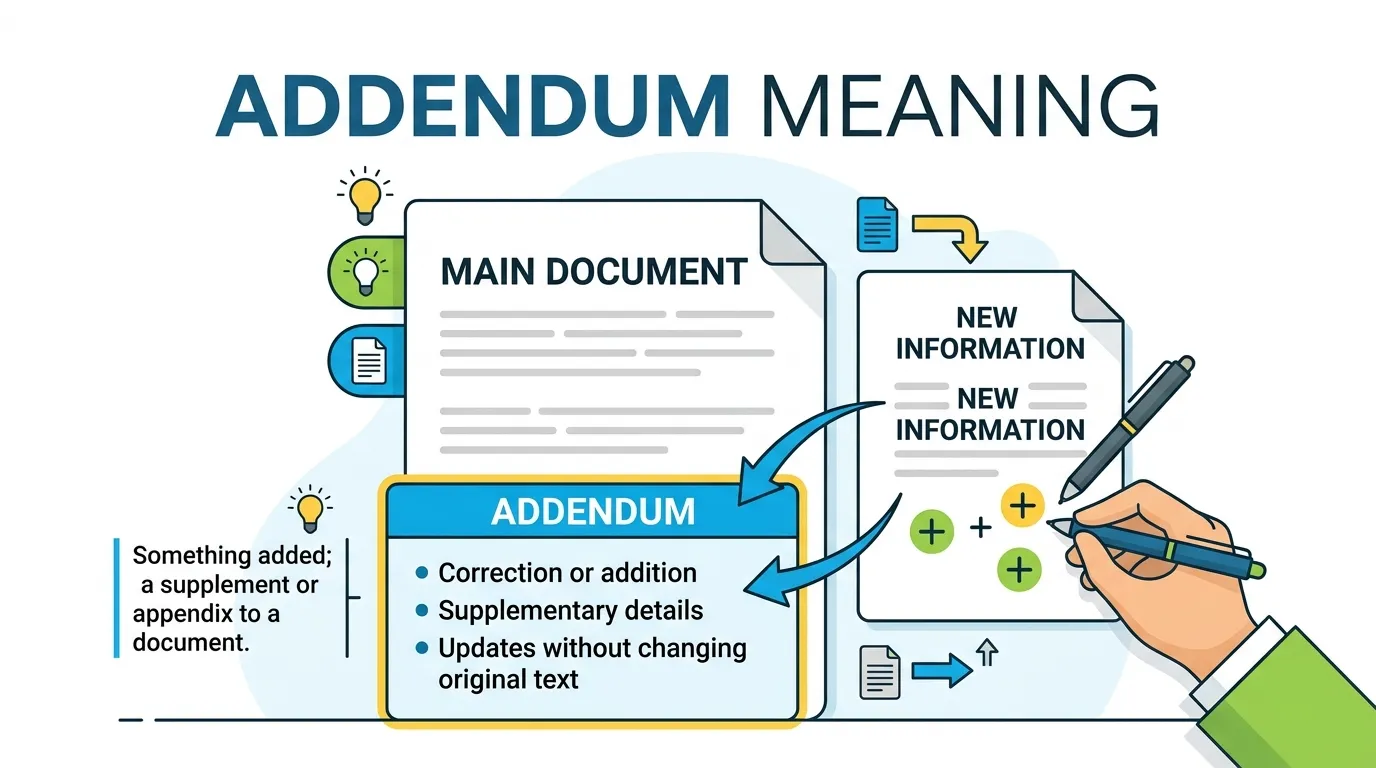
An addendum is a piece of writing tacked onto a document after that document was already considered finished.
It doesn’t rewrite what came before. It sits next to it, adding something new a date change, an extra clause, a correction, a new chapter of information.
Once you know that, the word stops feeling intimidating.
This guide breaks down where addendum comes from, how it’s actually used in 2026, and where people trip up on grammar and pronunciation.
Quick Answer
An addendum is something added to a finished document extra terms, updates, or details attached after the original was signed or published. The word comes from Latin, roughly meaning a thing that must be added.
The plural is technically addenda, though addendums has become common enough that most style guides now accept it too.
Where the Word Addendum Comes From
Here’s the part most quick-definition sites skip, and it actually matters. Addendum is a direct borrow from Latin. It’s the gerundive form of addere, the Latin verb for to add. A gerundive in Latin grammar carries a sense of obligation so addendum doesn’t just mean an added thing. It leans closer to a thing that needs to be added or a thing that ought to be supplied.
That distinction is small, but it’s why addenda tend to show up in formal, official writing rather than casual notes. The word was built to describe something necessary, not optional.
English absorbed the word more or less unchanged sometime in the late 1700s, mostly through academic and legal Latin still used across Europe at the time. Publishers picked it up first, tacking addenda pages onto the backs of books to correct or expand on the main text without reprinting the whole thing.
What Does Addendum Mean in Everyday Use?
Strip away the Latin, and here’s the plain-English version: an addendum is a supplement. Something extra, attached to something that already existed.
You’ll run into it in a few common places:
- Legal contracts an addendum adds new terms without erasing the original agreement.
- Books and reports an addendum tacks on updated facts, corrections, or new findings.
- Business proposals an addendum spells out changes made after the first draft went out.
- Real estate an addendum can adjust the closing date, price, or included items in a home sale.
Notice the pattern. In every case, the original document stays intact. The addendum rides along beside it.
Addendum vs. Amendment vs. Appendix vs. Supplement
This is where a lot of confusion happens, and honestly, most articles online blur these terms together instead of separating them cleanly.
Addendum vs. Amendment. An addendum adds new material. An amendment changes existing material. If your rental agreement gets a new clause about pets, that’s an addendum. If it changes the rent amount already written into the lease, that’s an amendment. Some contracts use the words loosely, which muddies things but strictly speaking, addition and alteration are two different actions.
Addendum vs. Appendix. An appendix is reference material charts, source data, background reading meant to support the main document. An addendum is closer to an update or a missing piece. Think of an appendix as extra context and an addendum as extra content that should have been there.
Addendum vs. Supplement. These two overlap a lot, and honestly, in casual use they’re nearly interchangeable. If there’s a difference, it’s tone: supplement sounds more neutral and everyday, while addendum sounds more formal and often legal.
A Worked Example
Say a freelance designer signs a contract in January to build a client’s website for $3,000. In March, the client asks for two extra landing pages that weren’t in the original scope. Instead of tearing up the whole contract, the designer writes a short addendum: This addendum adds two additional landing pages to the January 12 agreement, for an additional fee of $600, due upon completion. Both parties sign it. The original contract still stands the addendum just rides on top of it.
Is It Addendums or Addenda? The Plural Debate
Here’s a spot where sticklers and everyday speakers disagree.
Because addendum is a Latin word, its historically correct plural follows Latin rules: addenda. That’s still the form you’ll see in academic writing, formal legal documents, and most style guides like the Chicago Manual of Style.
[VERIFY: Merriam-Webster and most major dictionaries now list addendums as an accepted secondary plural, reflecting how English speakers naturally pluralize borrowed words over time.]
So which should you use? For formal or legal writing, stick with addenda. For casual business writing or everyday speech, addendums won’t raise many eyebrows anymore. Language just moves that way irregular plurals soften over generations.
How to Pronounce Addendum
It’s said as uh-DEN-dum, with the stress landing on the second syllable. The plural, addenda, is pronounced uh-DEN-duh.
People sometimes stumble on the first syllable, saying AD-en-dum instead. Both are understood, but uh-DEN-dum is the standard pronunciation you’ll hear from lawyers, editors, and news anchors alike.
How Common Is This Word Today?
Addendum isn’t a word people drop into casual conversation over coffee. It lives mostly in professional writing contracts, government filings, academic publishing, and real estate paperwork. If you work in law, publishing, or corporate business, you’ll see it constantly. If you don’t, you might only run into it once or twice a year, usually attached to a document you’re being asked to sign.
That said, its use hasn’t faded. If anything, the rise of remote work and digital contracts has made addenda more common, not less it’s a lot easier to email someone a one-page addendum than to redraft an entire agreement every time a small detail changes.
Quick Facts
| Category | Details |
| Meaning | Something added to a finished document; an update, extra term, or correction |
| Origin / Language | Latin gerundive form of addere, to add |
| Part of Speech | Noun |
| Pronunciation | uh-DEN-dum |
| Plural Form | Addenda (formal); Addendums (accepted informal) |
| Common Usage Context | Legal contracts, real estate, publishing, business proposals |
Related and Similar Words
| Word | Meaning | Origin | How It Differs From Addendum |
| Amendment | A formal change to existing text | Latin, emendare (to correct) | Changes what’s already there instead of adding new material |
| Appendix | Supporting material at the end of a document | Latin, appendere (to hang onto) | Reference or background info, not a required update |
| Supplement | Something that completes or adds to a thing | Latin, supplere (to fill up) | Broader and less formal; often used outside legal writing |
| Annex | A document attached to a main agreement, often in treaties | Latin, annectere (to bind to) | More common in international or governmental contracts |
| Corrigendum | A formal correction of an error in a printed text | Latin, gerundive of corrigere (to correct) | Fixes a mistake rather than adding new content |
| Rider | An added clause, often in insurance or entertainment contracts | Old English, from to ride along | Informal cousin of an addendum, common in insurance and music contracts |
FAQs
Q: Addendum meaning in farsi
A: In Farsi, addendum means an additional part or supplementary section added to a document.
Q: Addendum meaning in law
A: In law, an addendum is an additional document or provision added to an existing legal agreement.
Q: Addendum meaning in medical
A: In medical use, an addendum is extra information added to an existing medical record or report.
Q: Addendum meaning in accounting
A: In accounting, an addendum is additional information or a supplement added to an accounting document.
Q: Contract addendum meaning
A: A contract addendum is an additional document used to add or change terms in an existing contract.
Q: Addendum meaning business
A: In business, an addendum is additional information or terms attached to an existing document or agreement.
Q: Addendum meaning in tender
A: In a tender, an addendum is an official update or additional information issued after the original tender document.
Q: Addendum meaning in a lease
A: In a lease, an addendum is an additional document that adds or modifies specific terms of the rental agreement.
Conclusion
Addendum isn’t as complicated as it sounds. It’s simply an official add-on a way to update a finished document without tearing it apart and starting over. Once you know its Latin roots and how it differs from an amendment or an appendix, the word loses its intimidation factor fast.
If you’re drafting one yourself, keep it short, reference the original document by date, and make sure both sides sign off. That’s really all an addendum needs to do its job.
Discover More Post
- Prorated Meaning: Definition, Examples & More
- Hallelujah Meaning: A Simple Guide to Its Meaning
- Mi Amor Meaning: Discover the Romantic Meaning Now
- Moniker Meaning: Origin, Use & Examples

At goffaws.com, we believe laughter is as vital as a strong core. Much like Harper Lee’s gift for finding humor and truth in the everyday, we’re here to celebrate the lighter side of fitness. These CrossFit puns and jokes remind us that strength isn’t only measured in reps or rounds—it’s also in the ability to laugh through the burn. So lace up, grab your barbell, and get ready to lift your spirits as high as your next personal best.