Have you ever felt equally at home chatting in a lively group and then needing quiet time alone afterward?
Or noticed that the usual labels of introvert or extrovert never quite fit? Many students and teachers run into this exact puzzle when they meet the word ambivert.
Search results often give a one-line dictionary gloss and stop there, leaving readers unsure how the word actually works in real sentences or where it comes from.
This article settles the question. You’ll get a plain definition, the word’s history, clear examples across everyday and formal contexts, the mistakes people make, and a short practice set.
By the end you should feel confident using ambivert yourself and explaining it to others.
Quick Answer
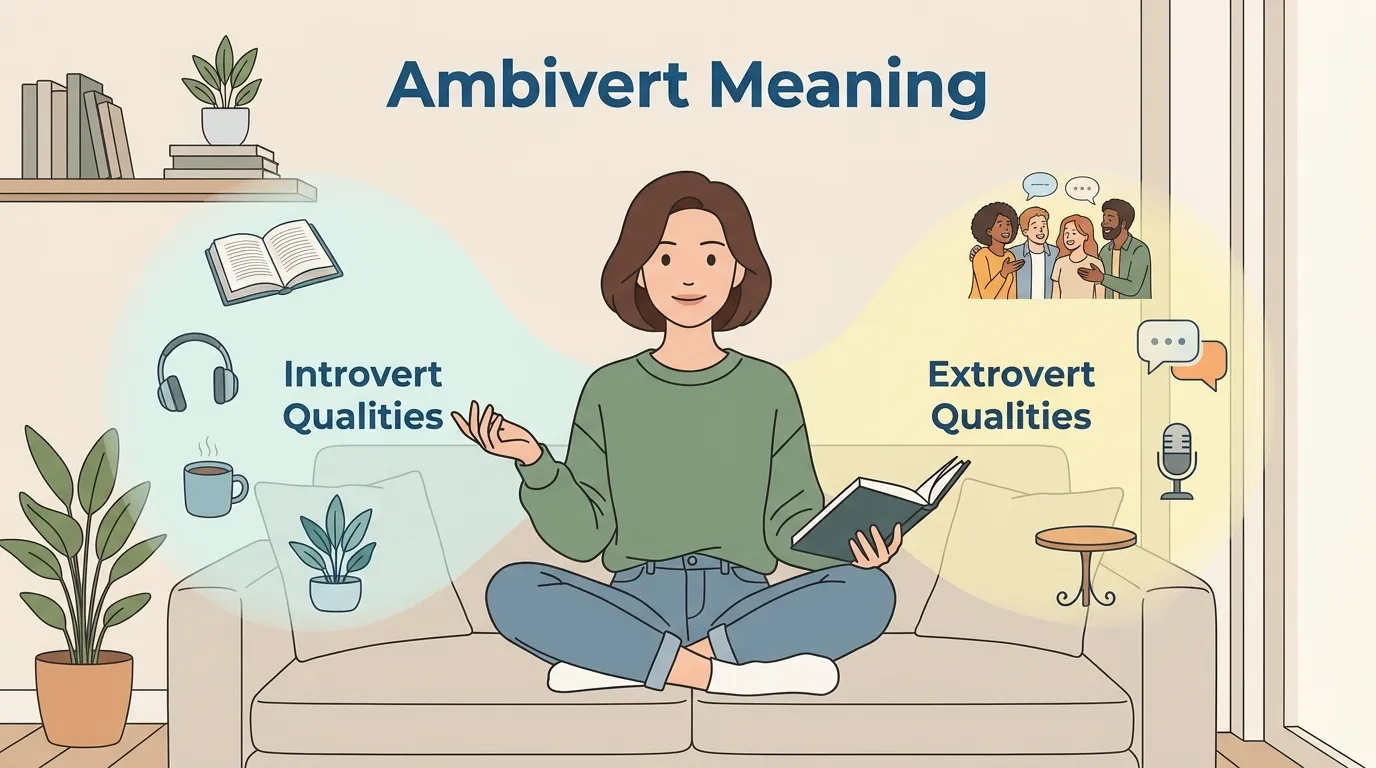
An ambivert is a person whose personality shows traits of both an introvert and an extrovert. Ambiverts can enjoy social energy and also need solitude; they adapt more flexibly than people who sit near either extreme of the spectrum.
Where This Comes From
The word ambivert was formed in English in the early twentieth century. It combines the Latin prefix ambi- (both or on both sides) with the ending -vert taken from introvert and extrovert. Those two earlier words themselves rest on Latin vertere, to turn.
Merriam-Webster and the Oxford English Dictionary credit the American psychologist Edmund S. Conklin with introducing ambivert (and the related noun ambiversion) in a 1923 journal article. He used the term for people whose outward or inward tendencies were not dominant but shifted with circumstances. A few later writers also linked the coinage to Kimball Young’s 1927 work, yet the earliest clear printed evidence points to Conklin. The word has remained a specialized psychology term that later moved into everyday discussion of personality.
British English vs. American English
Meaning does not differ between the two varieties. Pronunciation shows only a minor regional difference:
| Version | Pronunciation | Common Region |
| American | /ˈæm.bɪˌvɝːt/ | United States, Canada |
| British | /ˈæm.bɪ.vɜːt/ | United Kingdom, Australia, New Zealand |
Both forms are fully acceptable.
How to Use It Correctly
Treat ambivert as a countable noun. It names a person, so it takes the usual articles and plural form ambiverts.
- After a long conference day she realized she was an ambivert: the networking had been fun, yet she still needed an hour alone with a book.
- Teachers often notice ambiverts in mixed discussion groups; they speak up when the topic interests them and fall quiet when it does not.
- The manager described himself as an ambivert and arranged the office schedule so staff could choose collaborative or independent blocks.
Common Mistakes
| Incorrect | Correct | Why |
| She’s an ambivert so she hates parties. | She’s an ambivert, so she enjoys parties sometimes and solitude at others. | Ambiverts are not anti-social; they simply balance both sides. |
| Ambivert means the same as omnivert. | Ambivert describes a balanced mix; omnivert is a newer, less standard term for more extreme swings. | Keep the two distinct. |
| All quiet people are introverts, never ambiverts. | Quiet people may still be ambiverts if they also enjoy selected social settings. | Behavior depends on context and energy, not a single fixed label. |
Real-Life Examples
Text message: I’m such an ambivertloved the dinner but now I need the couch and silence.
Email: As an ambivert I work best with a mix of team meetings and focused solo time; could we adjust the weekly schedule?
Formal sentence: Recent classroom observation shows that ambiverts often serve as informal bridges between more reserved and more outgoing students.
Headline / social post: Why Ambiverts Make Flexible Leaders
Quick Practice
- Choose the better sentence: a) Only extreme introverts and extroverts exist; ambiverts are rare. b) Many people sit between the extremes and can be called ambiverts.
- Fill in the blank: After the crowded wedding, the __________ needed a quiet walk before the next event.
- Rewrite: He’s not shy or loudhe’s just in the middle. (Use ambivert)
Answers: 1-b; 2-ambivert; 3-He’s an ambivertneither extremely shy nor constantly loud.
FAQs
Q: Ambivert vs omnivert
A: An ambivert has both introvert and extrovert traits, while an omnivert may switch between extreme introversion and extroversion.
Q: Ambivert meaning example
A: An ambivert may enjoy socializing with friends but also need quiet time alone afterward.
Q: Ambivert meaning pronunciation
A: Ambivert is pronounced “AM-bih-vurt.”
Q: Ambivert meaning in psychology
A: In psychology, an ambivert describes someone who shows a balanced mix of introverted and extroverted traits.
Q: Introvert, extrovert ambivert meaning
A: An introvert prefers solitude, an extrovert enjoys social interaction, and an ambivert shows traits of both.
Q: Extrovert and ambivert meaning
A: An extrovert usually gains energy from social interaction, while an ambivert can enjoy both social time and solitude.
Q: Ambivert girl meaning
A: An ambivert girl is someone who can enjoy social situations while also valuing quiet time alone.
Q: Ambivert in a sentence
A: “She is an ambivert who loves parties but also enjoys spending weekends alone.”
Related Terms
- Introvert
- Extrovert (also spelled extravert)
- Ambiversion
Conclusion
An ambivert is simply a person who sits between the classic poles of introversion and extraversion, comfortable drawing energy from both company and solitude. The word itself is a neat English formation from Latin roots, first recorded in psychological writing a century ago and now common in everyday discussion of personality.
When you use it, keep the balance clear: ambiverts are not half and half in a rigid sense, nor are they automatically better or worse than people nearer either end of the spectrum. They simply adapt. In my own classrooms I have watched students who once forced themselves into an introvert or extrovert box relax once they met the word ambivert and recognized their own flexible pattern.
Discover More Post
- How to Wilt Spinach: Quick & Easy Guide
- How Long for Concrete to Cure? Get the Right Answer
- Macabre Meaning: Definition, Examples & More
- What Is the Voila Meaning? Easy Definition & Examples